
 CRY1
CRY1 MNC4
MNC4 MIL2
MIL2 VEN0
VEN0 GRO2
GRO2 FOR3
FOR3 LIV
LIV NFO
NFO BOU
BOU EVE
EVE COV
COV HUL
HUL TOT
TOT NEW
NEW CHE
CHE BHA
BHA LEE
LEE BRE
BRE SUN
SUN FUL
FUL MAN
MAN IPS
IPS FIO
FIO FRO
FRO MON
MON UDI
UDI SAS
SAS TOR
TOR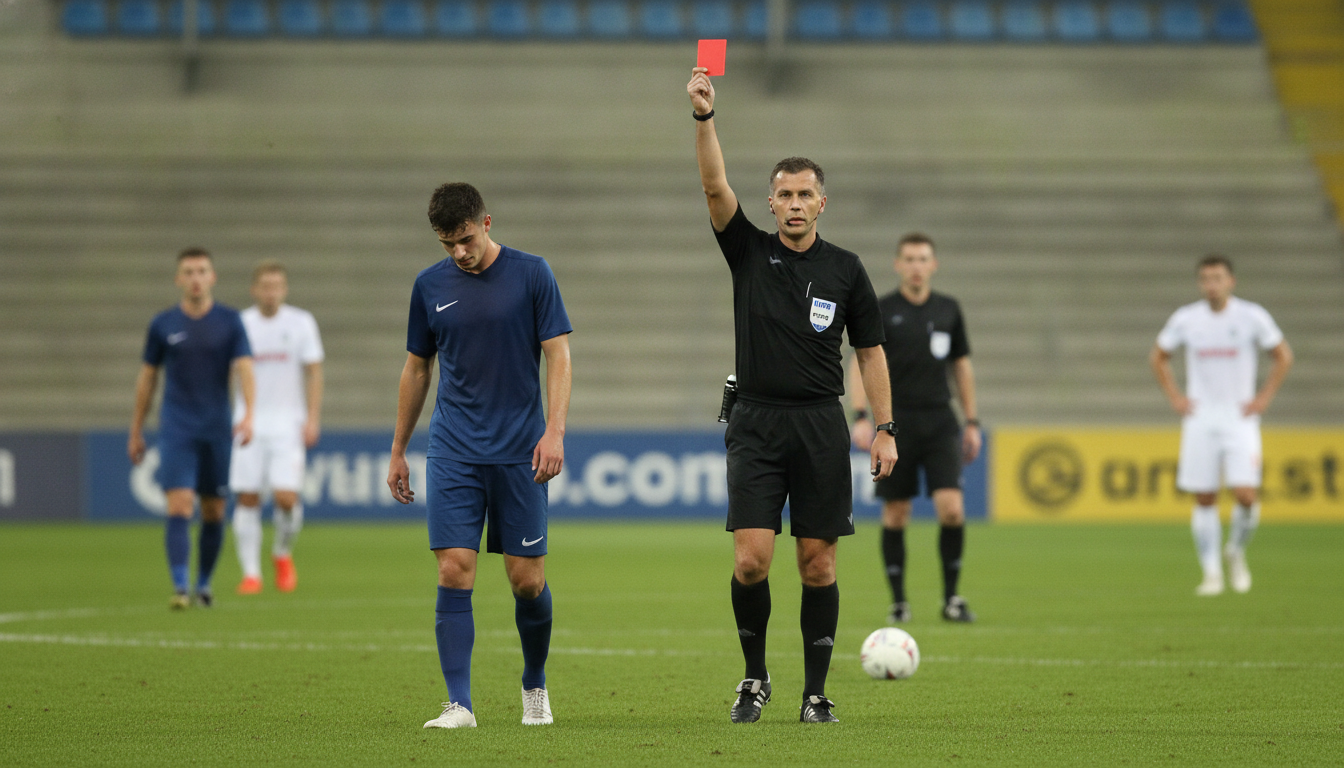
What happens if a footballer gets a red card?
What happens if a footballer gets a red card?
The referee reaches into their pocket, holds up a red card, and the player walks. But what does the rulebook actually say happens from that moment on — and what counts as a sending-off offence in the first place?

The moment itself is hard to miss. A referee stops play, calls the player over, and raises a red card above their head. The player must leave the field immediately — no argument, no substitution to replace them. Their team plays on with ten men for the rest of the match.
That is the core of it. A red card means the player is sent off and cannot return.
The Laws of the Game, written and maintained by IFAB, set out exactly which offences earn a sending-off. The list includes violent conduct, serious foul play, denying an obvious goal-scoring opportunity (known as DOGSO), and receiving a second yellow card in the same match. Each of those triggers an automatic red card.
What happens next on the pitch depends on the offence. If the foul happened outside the penalty area, play restarts with a free kick. If it happened inside the penalty area and denied a clear chance to score, it restarts with a penalty kick. A corner kick or throw-in can also be the restart if that is what the situation calls for.
The rulebook is worth reading closely, because the wording is more precise than most people expect. On violent conduct, Law 12 states: "The attacker's offence is violent conduct and punished with a sending-off (red card)." On denying a goal: "It is a penalty kick and the goalkeeper is sent off (red card, RC) for denying the opposing team a goal."
That second example covers a situation most fans have never seen: a goalkeeper who uses an object — a water bottle, say — to stop a shot on the goal line. The Laws treat that the same as any other denial of a goal. Red card, penalty kick.
The rule on attempted violence is the one that surprises people most. You do not have to make contact to be sent off. Law 12 is unambiguous: "Attempted violence must be punished as a sending-off (red card, RC) offence." A swing that misses, a kick that connects with air — both are enough.
The edge case a reader probably did not think to ask about is what happens when a player commits two offences at exactly the same moment. A defender might make a reckless foul that would normally earn a yellow card, but that same foul also denies an obvious goal-scoring opportunity. Law 12 resolves this directly: "When two offences are committed at the same time, the more serious offence is punished, so the defender receives a red card for the DOGSO offence rather than a yellow card for the reckless foul." The more serious charge wins, every time.
Sumber1 sumber
IFAB Laws of the Game — Law 12: Fouls and Misconduct, IFAB Laws of the Game — Law 12: Fouls and Misconduct, IFAB Laws of the Game — Law 12: Fouls and Misconduct, IFAB Laws of the Game — Law 12: Fouls and Misconduct
Redaksi Flagside baca setiap berita yang kami terbitkan. Kami kerja dari pers bola, tulis sendiri bukan cuma reprint, dan cek akurasi serta sumber setiap artikel. Semua outlet yang masuk ke berita ini tercantum di bawah Sumber.



Bola hari ini, di inbox jam 7 pagi. Cuma itu.
Pilihan pertandingan malam, apa yang lagi terjadi di transfer window, dan satu kolom yang harus dibaca hari ini. Tanpa iklan. Tanpa tips. Tanpa operator.
Unsubscribe sekali klik. Kami tidak bagikan email.
Comments
Loading comments…