
 ALG2
ALG2 NIG1
NIG1 JOR0
JOR0 VEN0
VEN0 RUS3
RUS3 NGA3
NGA3 IND1
IND1 URU6
URU6 CHN0
CHN0 TJK1
TJK1 KOR2
KOR2 UZB0
UZB0 LIE0
LIE0 GIB2
GIB2 RWA0
RWA0 KEN0
KEN0 MRI2
MRI2 SRI3
SRI3 UGA1
UGA1 COD1
COD1 ARG
ARG BEN
BEN COL
COL PER
PER USA
USA CAN
CAN MEX
MEX CHI
CHI
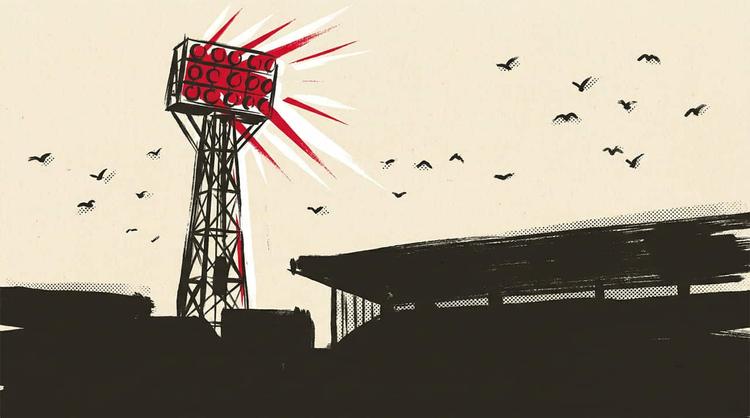
Frankenstadion, Nuremberg, photographed in 2012 — the venue that hosted the Portugal–Netherlands round-of-16 tie six years earlier.
Twenty cards, four reds — and the legend has it backwards
The Portugal–Netherlands match at the 2006 World Cup produced more cards than any other ninety-minute fixture in World Cup history. The story told about it ever since gets the central fact wrong.
Written with AI and checked automatically before publishing. How we work
Portugal 1 Netherlands 0. Nuremberg, 25 June 2006. Maniche scored in the 23rd minute. It was the only goal, and it was almost beside the point.
Valentin Ivanov, the Russian referee, showed sixteen yellow cards and four red cards across ninety minutes — a record for a FIFA-administered international tournament. That number is real. What the retellings consistently miss is what those four red cards actually were.
Every dismissal was a second yellow. Costinha went at 45+1, Khalid Boulahrouz at 63, Deco at 78, Giovanni van Bronckhorst at 90+5. Not one player was sent off for violent conduct. The match produced no straight red cards at all.
The one act that looked like violence was treated differently. Luis Figo headbutted Mark van Bommel during a touchline melee around the 60th minute and received a yellow card — nothing more. So the referee who is remembered for losing control of a violent match was, in fact, strict on card accumulation and lenient on the one act that resembled violence. The legend has the picture inverted.
FIFA announced that Ivanov would referee no further matches at the tournament. Then Sepp Blatter, FIFA's own president, went further — publicly stating that Ivanov should have given himself a yellow card for his own performance. Blatter subsequently regretted the remark and promised an official apology. That sequence — a governing body's president attacking his own official in public and then having to pull back — is its own story, and it runs alongside the card count rather than explaining it.
The two coaches blamed each other with near-identical language. Marco van Basten said: "I think it was very bad. It's a pity that the referee made a mess of this game." On Portugal, he added: "If you speak of fair play, then look in the mirror first. Portugal are very experienced in dirty tactics and time-wasting." Luiz Felipe Scolari pointed the same charge the other way: "FIFA always talks about fair play but tonight we saw several gestures that were anything but." Both men invoked fair play. Each meant the opposition.
Ivanov's father — also named Valentin Ivanov, a Soviet forward who played at the 1958 and 1962 World Cups and died in 2011 — defended his son publicly, arguing that FIFA had itself demanded referees be tough on players at that tournament. That argument is rarely included in accounts of the match.
The card record itself requires a qualification. Netherlands against Argentina at the 2022 World Cup produced more cards in total, but that match went to extra time and penalties. The accurate claim is that the Portugal–Netherlands match holds the record for cards shown inside ninety minutes at a World Cup.
As for Ivanov: his refereeing career ran to 2006. He later headed the refereeing and inspection department of the Russian Football Union, then became head of the refereeing department of the Qatar Football Association. The official FIFA removed from its own tournament went on to run refereeing for two national federations.
Sources4 sources
FIFA, BBC Sport, The Guardian, Photo: DerHans04 via Wikimedia Commons (CC BY-SA 3.0)
We name and link every outlet this article draws on, and rewrite their reporting in our own words rather than reprinting it.


The day's football, in your inbox at 7 AM. Nothing else.
Pick of the night's matches, what the transfer window's doing, and the one column you should read today. No ads. No tips. No operators.
One-click unsubscribe. We do not share emails.
Comments
Loading comments…