
Why do referees have foam at free kicks?
A referee jogs ten yards from the ball, bends down and draws a quick line of white foam on the grass before a free kick. Here's what that spray is actually doing.
Written with AI and checked automatically before publishing. How we work
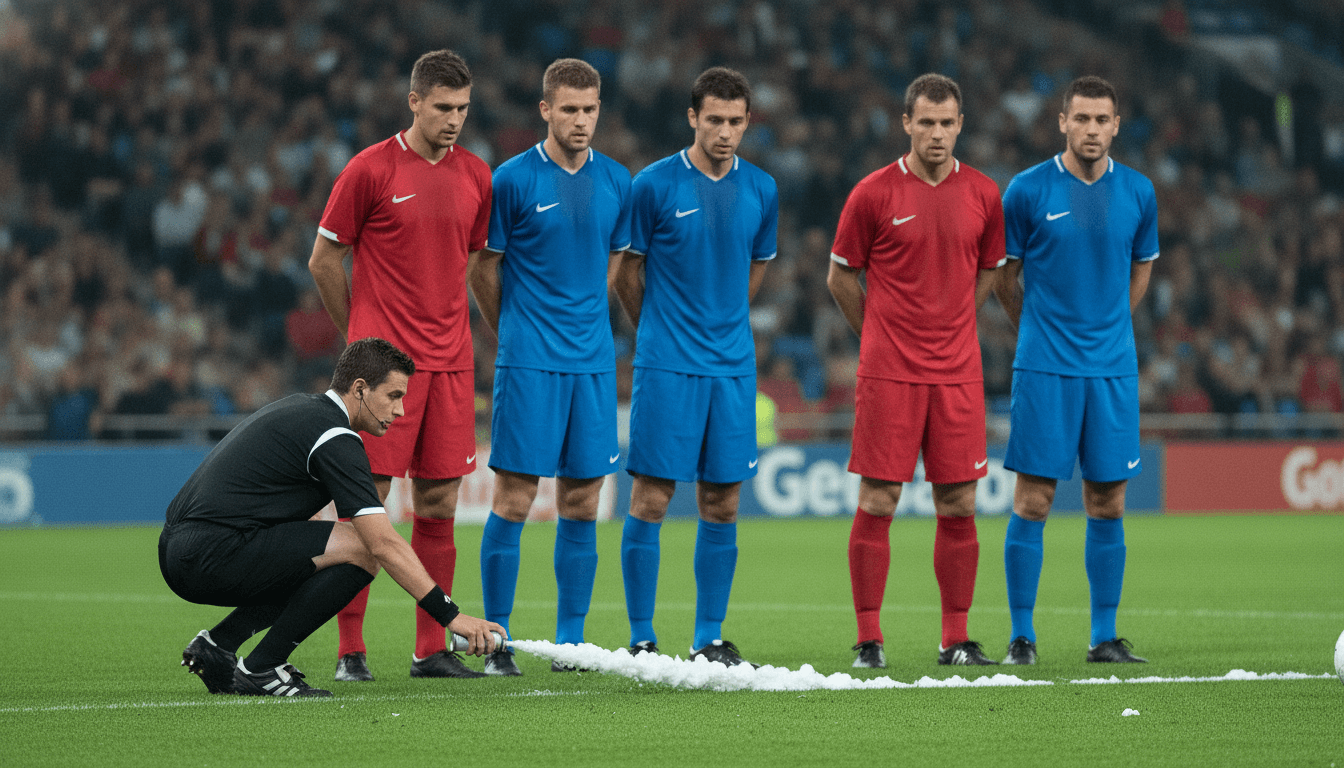
Picture a free kick being set up. The referee paces out the distance, crouches, and sprays a short line on the pitch in front of the wall of defenders. Then he walks back to the ball and sprays a small mark right next to it too. Within a minute, both lines are gone, like they were never there.
That foam is called vanishing spray, and it has two jobs. The line in front of the wall marks exactly how far back the defenders have to stand. The mark by the ball shows precisely where it has to be placed, so the kicker can't quietly nudge it forward a yard before striking it. Both marks disappear on their own after about a minute, leaving no permanent trace on the grass.
The reason it exists is almost comically simple: players crept forward. Before the spray, defensive walls would inch toward the ball the moment the referee turned to set the distance, and attacking teams would sometimes do the same thing in reverse, shuffling the ball a step closer to goal before the kick. Referees ended up pacing back and forth, shouting, waving arms, and re-measuring, which burned time and sparked arguments that went nowhere. A can of foam solved it instantly. Once there's a visible line on the turf, there's nothing to argue about, the wall is either behind it or it isn't, and the ball is either on the mark or it isn't.
The spray itself is a simple mix, usually water, a foaming agent and a bit of butane as a propellant, pressurised in a can the referee carries holstered on his hip or thigh, like a tool he reaches for mid-match rather than something built into the kit. He pulls it out, applies the two lines, clips the can back, and plays continues. The whole routine takes a few seconds, which is part of why it caught on so fast once leagues started using it: it cost almost nothing in time and gave officials an answer to a dispute that used to be purely verbal.
It became especially common in competitions like the Premier League, where the pace of the game means fewer stoppages are tolerated and referees need a tool that settles an argument on sight rather than through discussion. Once one major league adopted it and broadcasters noticed how clean it looked on camera, a crisp white line appearing and fading on green grass, other competitions followed, and it spread from a quirky South American invention into something seen in televised football everywhere.
The one thing that catches people out is how temporary it is. It isn't paint and it isn't chalk; it's designed specifically to vanish within roughly sixty seconds so it never builds up on the pitch or leaves a mark that matters for the rest of the match. If a game has twenty free kicks in a half, the surface still looks completely untouched by halftime. That's also why referees sometimes spray a fresh line again if the kick is delayed for any reason, the first one has already faded by the time play restarts.



The day's football, in your inbox at 7 AM. Nothing else.
Pick of the night's matches, what the transfer window's doing, and the one column you should read today. No ads. No tips. No operators.
One-click unsubscribe. We do not share emails.
Comments
Loading comments…