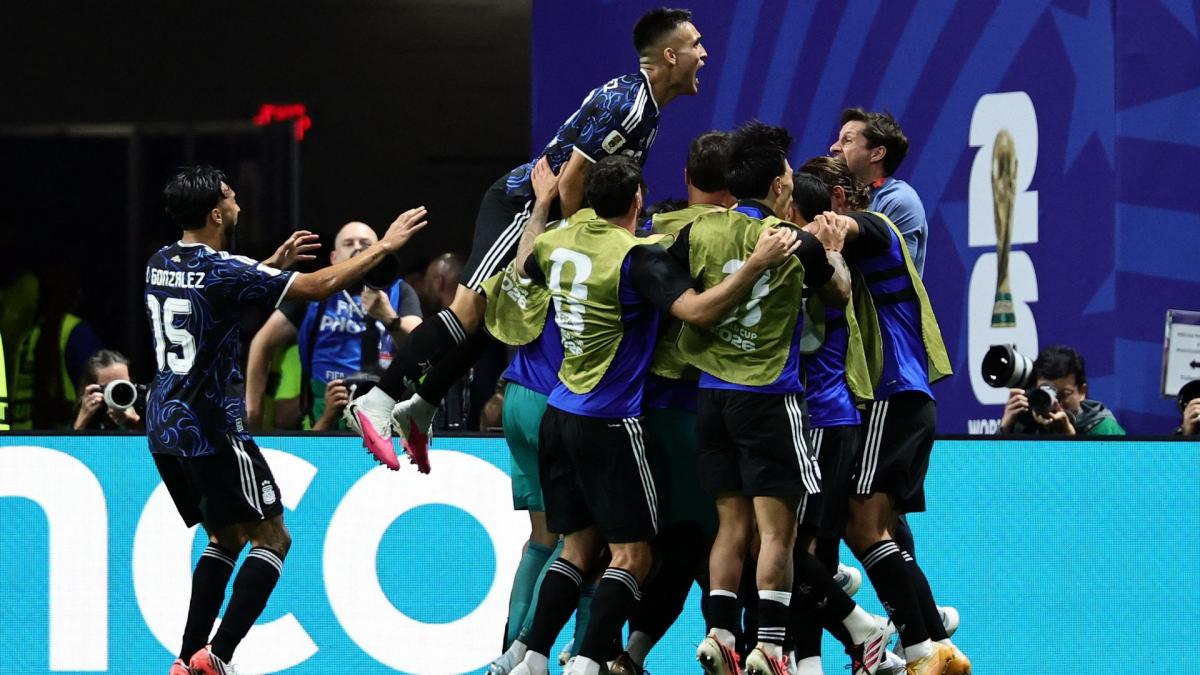
There is a version of this story that has been written a hundred times, in a hundred languages, across two decades of football. And yet here we are again — Lionel Messi, Argentina, a World Cup final. Except this time, the weight of it is different. This time, everyone in that dressing room knows it might be the last one.
According to The Athletic, there is a palpable sense of destiny running through the Argentina camp ahead of Sunday's final — the kind that doesn't come from a press conference or a carefully worded captain's quote, but from the way a group of players move around their talisman when the cameras aren't rolling. Messi, beaming. Argentina, bouncing. A nation of 46 million people holding its breath.
Defending champions. Potential back-to-back winners. And at the centre of all of it, a 38-year-old from Rosario who has already won the thing once and apparently decided that once wasn't enough.
The 2022 Qatar final was supposed to be the full stop on Messi's World Cup story. It turned out to be a comma. Now Argentina have navigated an entire tournament on home soil — across the United States, Canada and Mexico — to reach the final again, and the question the sport has been asking for twenty years has one more answer to give.
The Athletic's feature framing is atmospheric rather than hard-news, and specific details — the semi-final scoreline, the final opponent, the confirmed venue — are not yet verified from a single source. Flagside will update with confirmed match facts as they are reported. What is clear from The Athletic's reporting is the emotional register inside the Argentina camp: this is a squad that understands exactly what it is carrying.
In 2014, Messi reached the final and lost. In 2022, he won it in the most dramatic fashion the sport has ever produced — a match that finished 3-3 after extra time before Argentina won on penalties against France. That night in Lusail felt like an ending. A complete one.
This is something else. A sequel nobody quite expected, written by a player who was supposed to be winding down at Inter Miami and instead turned up at a World Cup and refused to be a footnote.
He didn't come here to wave goodbye. He came here to win.
For Argentina, the football context is straightforward: win on Sunday and they become back-to-back world champions for the first time since 1978 and 1986 — the era of Kempes and Maradona. The symmetry is not lost on anyone. Messi has spent his entire career in the shadow of Maradona's 1986 tournament. He answered that in Qatar. Now he has the chance to do something even Maradona never managed.
The sport doesn't often hand you a narrative this clean. When it does, you pay attention.
There is a version of this story that has been written a hundred times, in a hundred languages, across two decades of football. And yet here we are again — Lionel Messi, Argentina, a World Cup final.
Bronnen
The Athletic — Football
Flagside-artikelen zijn originele stukken samengesteld uit meerdere bronnen. We citeren elke outlet die in het stuk verwerkt is.
Hoogtepunten van de nacht, wat de transfermarkt doet, en het ene stuk dat je vandaag moet lezen. Geen ads. Geen tips. Geen operators.
Eenmalig afmelden. We delen je e-mailadres niet.
“Stays on Argentina — different angle, same beat.”
 INT
INTIt was supposed to be different. Thomas Tuchel arrived with a reputation built on pressing systems, positional boldness, and the kind of tactical aggression that wins Champions League finals. Then Arg
“Stays on Argentina — different angle, same beat.”
INTIt was supposed to be different. Thomas Tuchel arrived with a reputation built on pressing systems, positional boldness, and the kind of tactical aggression that wins Champions League finals. Then Arg