In 2014, Germany were the best team on the planet — organised, relentless, tactically coherent, and built on a decade of deliberate structural work. Twelve years later, they are out of another World Cup in the early stages, making it three consecutive tournaments where the exit arrived far too soon for a nation of their stature. The question is no longer whether something has gone wrong. It is whether Germany can even agree on what going right would look like.
Three World Cups. Three early exits. For context: Germany had never gone out in the group stage before 2018. They managed it twice in a row, and now the pattern has extended into the knockout rounds without ever threatening the latter stages. The 2014 triumph in Brazil feels less like recent history and more like a different era of German football — because structurally, it was.
A Guardian columnist argued this week that the root cause is not a talent shortage and not the wrong head coach, but something harder to fix: no settled footballing identity, and no institutional thread to build one around. That framing is editorial opinion rather than confirmed institutional diagnosis, but it is difficult to look at the last decade and find a compelling counter-argument. BBC Sport's tournament coverage corroborates the bare facts: three exits, three different head coaches, zero deep runs.
The Germany side that lifted the trophy in Rio was the product of a structural revolution that began after the humiliation of Euro 2000. The DFB overhauled its youth academies, standardised coaching methodology across the Bundesliga, and gave Joachim Löw the time — fourteen years as head coach — to embed a clear identity: high press, positional fluidity, technical quality at every line. It was boring to describe and devastating to face.
What followed the 2018 collapse was the opposite of that patience. Löw survived one cycle too long, Hansi Flick arrived with goodwill from his Bayern Munich treble but found a squad in philosophical drift, and Julian Nagelsmann inherited a project without a settled spine. Each transition brought a new tactical language, a reshuffled hierarchy, and a different answer to the question of who Germany's best eleven actually were. The squad never lacked quality — it lacked a shared grammar.
This is what makes the decline genuinely puzzling rather than simply sad. Germany have produced Jamal Musiala, Florian Wirtz, and Leroy Sané in the same generation — players who would walk into almost any international side in the world. The Bundesliga has been competitive and tactically rich. The raw material has not dried up.
What has dried up is the connective tissue: the agreed roles, the automatic understanding of shape and press triggers, the institutional memory that turns a collection of good players into a team that knows how to win a tournament. You can see it in how Germany have looked in knockout football — technically capable in moments, structurally uncertain when it matters most.
The Guardian's argument — that Germany must reconnect with a coherent footballing identity rather than chase results through personnel changes — is the kind of thing that sounds obvious until you consider how difficult it is to execute inside a federation under pressure. The DFB will face calls for immediate fixes: a new coach, a new captain, a new system. The harder ask is structural patience, and German football has not demonstrated much of that since 2018.
Three exits in a row changes the conversation, though. At some point, the evidence becomes impossible to route around. Germany are no longer a tournament team by default — and the first step to becoming one again is admitting that the problem runs deeper than the last squad selection.
They have done this rebuild once before. It took a decade. The clock started again somewhere around 2018, and it is still running.
In 2014, Germany were the best team on the planet — organised, relentless, tactically coherent, and built on a decade of deliberate structural work.
Fontes
The Guardian — Football
Artigos do Flagside são produções originais sintetizadas de múltiplas fontes. A gente cita cada veículo que alimentou a matéria.
O melhor dos jogos da noite, o que tá rolando na janela de transferências e a coluna que você tem que ler hoje. Sem anúncios. Sem dicas. Sem operadoras.
Desinscrição em um clique. A gente não compartilha emails.
“Stays on World Cup — different angle, same beat.”
 SELEÇÕES
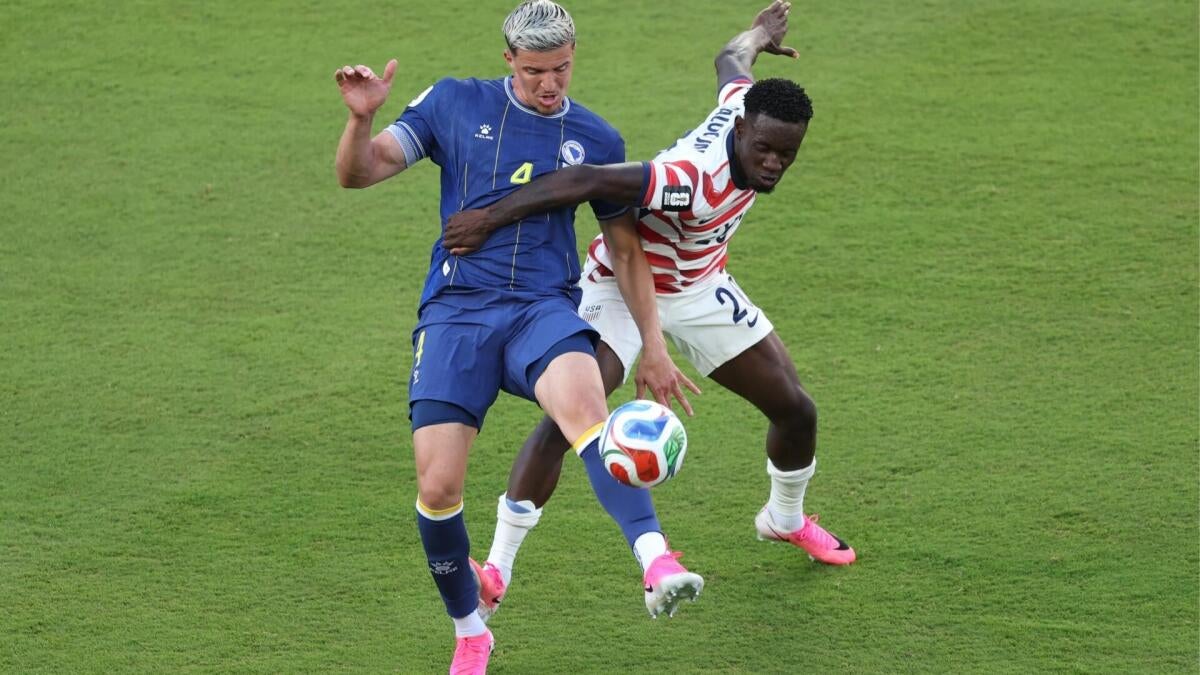
Folarin Balogun will miss the USA's Round of 16 tie at the 2026 World Cup — and there is nothing anyone can do about it. The automatic one-game ban that follows a straight red card is non-negotiable u
“Stays on World Cup — different angle, same beat.”
SELEÇÕESFolarin Balogun will miss the USA's Round of 16 tie at the 2026 World Cup — and there is nothing anyone can do about it. The automatic one-game ban that follows a straight red card is non-negotiable u