
 CEL1
CEL1 OSA1
OSA1 BAR1
BAR1 ATH0
ATH0 AGF1
AGF1 SLB3
SLB3 CSKA0
CSKA0 OFI2
OFI2 THUN2
THUN2 LECH2
LECH2 AND2
AND2 KAI0
KAI0 FER2
FER2 TRAB0
TRAB0 AJA5
AJA5 SION2
SION2 ATA1
ATA1 FCSG2
FCSG2 FCN3
FCN3 VIE0
VIE0 SCB0
SCB0 BBL1
BBL1 VIK1
VIK1 BHA3
BHA3 TRO0
TRO0 RIJE1
RIJE1 MID1
MID1 HIBS0
HIBS0 GENT1
GENT1 LAR0
LAR0 LRI0
LRI0 PART0
PART0 GET0
GET0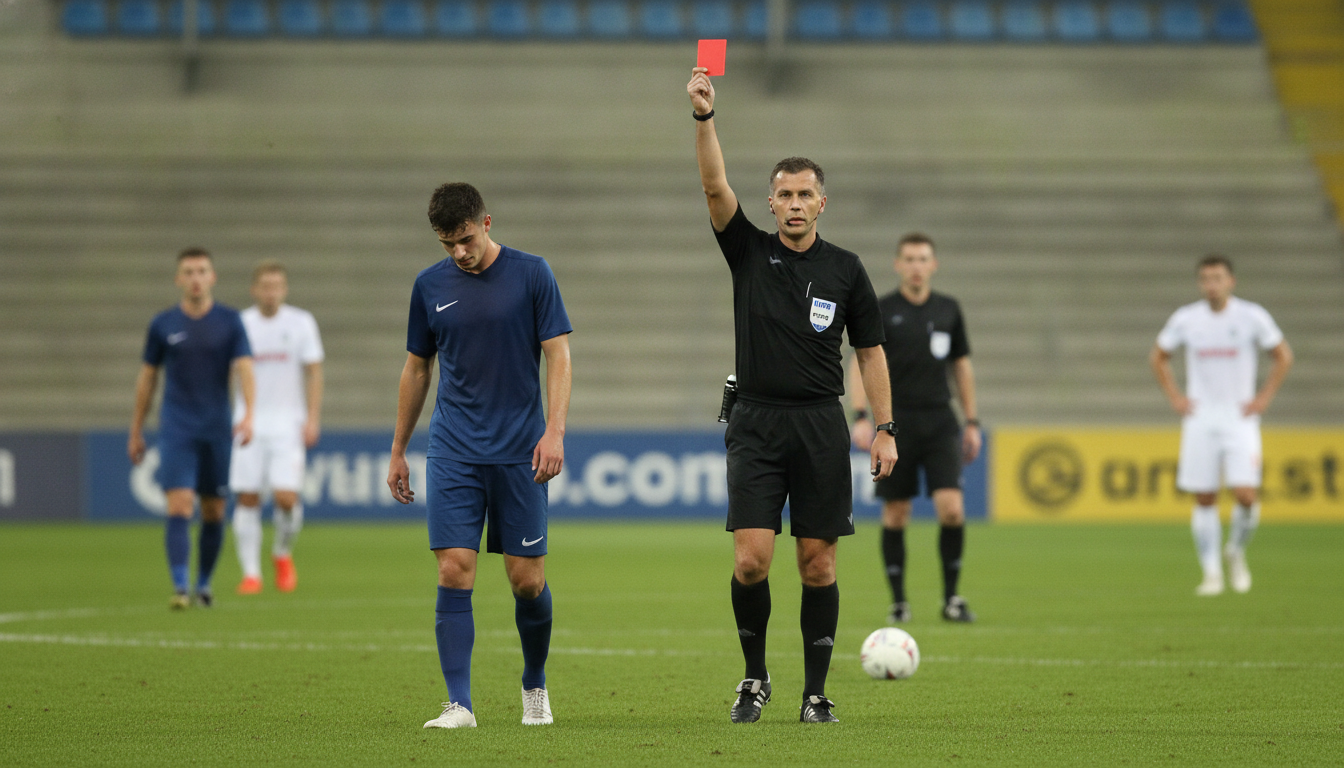
What happens if a footballer gets a red card?
What happens if a footballer gets a red card?
The referee reaches into their pocket, holds up a red card, and the player walks. But what does the rulebook actually say happens from that moment on — and what counts as a sending-off offence in the first place?

The moment itself is hard to miss. A referee stops play, calls the player over, and raises a red card above their head. The player must leave the field immediately — no argument, no substitution to replace them. Their team plays on with ten men for the rest of the match.
That is the core of it. A red card means the player is sent off and cannot return.
The Laws of the Game, written and maintained by IFAB, set out exactly which offences earn a sending-off. The list includes violent conduct, serious foul play, denying an obvious goal-scoring opportunity (known as DOGSO), and receiving a second yellow card in the same match. Each of those triggers an automatic red card.
What happens next on the pitch depends on the offence. If the foul happened outside the penalty area, play restarts with a free kick. If it happened inside the penalty area and denied a clear chance to score, it restarts with a penalty kick. A corner kick or throw-in can also be the restart if that is what the situation calls for.
The rulebook is worth reading closely, because the wording is more precise than most people expect. On violent conduct, Law 12 states: "The attacker's offence is violent conduct and punished with a sending-off (red card)." On denying a goal: "It is a penalty kick and the goalkeeper is sent off (red card, RC) for denying the opposing team a goal."
That second example covers a situation most fans have never seen: a goalkeeper who uses an object — a water bottle, say — to stop a shot on the goal line. The Laws treat that the same as any other denial of a goal. Red card, penalty kick.
The rule on attempted violence is the one that surprises people most. You do not have to make contact to be sent off. Law 12 is unambiguous: "Attempted violence must be punished as a sending-off (red card, RC) offence." A swing that misses, a kick that connects with air — both are enough.
The edge case a reader probably did not think to ask about is what happens when a player commits two offences at exactly the same moment. A defender might make a reckless foul that would normally earn a yellow card, but that same foul also denies an obvious goal-scoring opportunity. Law 12 resolves this directly: "When two offences are committed at the same time, the more serious offence is punished, so the defender receives a red card for the DOGSO offence rather than a yellow card for the reckless foul." The more serious charge wins, every time.
Fuentes1 fuente
IFAB Laws of the Game — Law 12: Fouls and Misconduct, IFAB Laws of the Game — Law 12: Fouls and Misconduct, IFAB Laws of the Game — Law 12: Fouls and Misconduct, IFAB Laws of the Game — Law 12: Fouls and Misconduct
Los editores de Flagside leen cada pieza que publicamos. Trabajamos desde la prensa futbolera, escribimos nuestro propio contenido en lugar de reproducir el de otros, y verificamos cada artículo por precisión y fuentes. Todos los medios que alimentaron esta pieza están nombrados bajo Fuentes.



El fútbol del día, en tu bandeja a las 7 AM. Nada más.
Lo mejor de los partidos de la noche, qué está haciendo la ventana de traspasos, y la columna que debes leer hoy. Sin anuncios. Sin pronósticos. Sin operadores.
Desuscripción con un clic. No compartimos emails.
Comments
Loading comments…