
 CHN0
CHN0 NZL3
NZL3 FIJ2
FIJ2 PNG0
PNG0 COK1
COK1 TAH3
TAH3 VAN4
VAN4 NCD1
NCD1 MEX1
MEX1 COL1
COL1 CAN1
CAN1 CHI0
CHI0 USA4
USA4 PER1
PER1 SEY
SEY SRI
SRI MLT
MLT LIE
LIE JOR
JOR SYR
SYR BOL
BOL PAR
PAR KGZ
KGZ MDV
MDV JPN
JPN VEN
VEN KOR
KOR URU
URU
The Bellingham penalty problem, explained
Penalty shouts involving Jude Bellingham tend to split opinion faster than almost any other player in Europe, and it isn't an accident. His style of play puts him in exactly the positions where the laws around contact are hardest to apply consistently.
Written with AI and checked automatically before publishing. How we work
Why his name keeps coming up
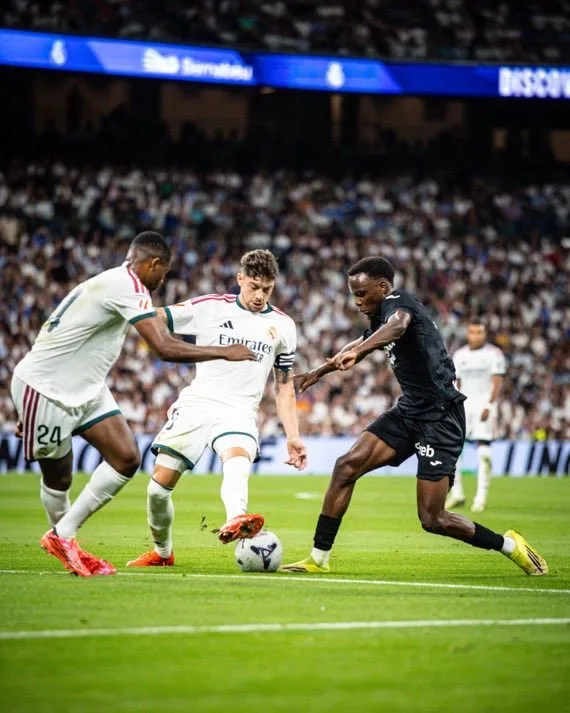
Bellingham isn't a penalty-box poacher waiting on the shoulder of the last defender. He arrives late, from deep, at pace, often driving diagonally across a defender rather than running in a straight line. That movement pattern is precisely the kind that produces marginal, debatable contact: a trailing leg, a shoulder brush, a shirt tug that may or may not have affected his stride. Strikers who spin off a defender in the six-yard box tend to draw cleaner, more obvious fouls. Midfielders arriving from range create contact that referees have to judge in real time, at speed, from an angle that rarely shows the full picture.
What the law actually asks referees to judge
The laws of the game don't require a defender to make zero contact. They require the referee to decide whether contact was careless, reckless or excessive, and whether it affected the attacker in a meaningful way. That is a judgment call, not a measurement, which is why two officials can watch the same passage of play and reach opposite conclusions. A trailing arm, a foot that catches an ankle a fraction after the ball has gone, a nudge in the back as a player changes direction: all of these sit in a grey zone where the letter of the law leaves room for interpretation.
Where VAR fits, and why it doesn't settle things
VAR was built to correct clear and obvious errors, not to referee every contact from scratch. That threshold matters enormously in cases like this. If the on-field referee waves away an appeal and the replay shows contact that is debatable rather than blatant, VAR is instructed to leave the decision alone, even if a neutral watching at home might have given it. The reverse is also true: if a penalty is awarded on the field, VAR will generally not intervene unless the contact is shown to be minimal or non-existent. That asymmetry is often what fuels the loudest arguments. Fans see the same replay and disagree not because the technology failed, but because the technology was never designed to remove subjectivity, only to catch the most obvious mistakes.
The role of reputation and history
There is also a pattern effect that shapes how these calls are received rather than how they are made. A player known for going down easily earns a level of suspicion from referees and pundits that follows him into every contested moment, fair or not. A player known for staying on his feet and playing through contact tends to get the benefit of the doubt when he does go down, because it looks out of character. Where a player like Bellingham sits on that spectrum affects the split-second read a referee makes just as much as the contact itself, even if officials would never frame it that way.
So was it a penalty
Almost every Bellingham penalty shout comes down to the exact contact: a trailing leg, a shoulder, a fraction of a second either side of the ball. The law gives referees discretion by design, and VAR is built to respect that discretion rather than override it. A player who repeatedly arrives late and at an angle into the box will keep putting officials in that grey zone, replayed from six angles and argued about for a week.
The day's football, in your inbox at 7 AM. Nothing else.
Pick of the night's matches, what the transfer window's doing, and the one column you should read today. No ads. No tips. No operators.
One-click unsubscribe. We do not share emails.
Comments
Loading comments…