 FUL1
FUL1 MAN1
MAN1 BOU0
BOU0 LIV1
LIV1 LEE0
LEE0 CRY0
CRY0 MNC5
MNC5 SUN3
SUN3 VAL2
VAL2 RSO3
RSO3 DEP1
DEP1 BET1
BET1 VIL3
VIL3 LEV1
LEV1 ATM2
ATM2 RMA1
RMA1 GET1
GET1 MCF0
MCF0 TSG0
TSG0 CHI1
CHI1 ARR0
ARR0 KAI0
KAI0 MAR0
MAR0 ORL2
ORL2 MIL1
MIL1 DUR1
DUR1 NCD
NCD SOL
SOL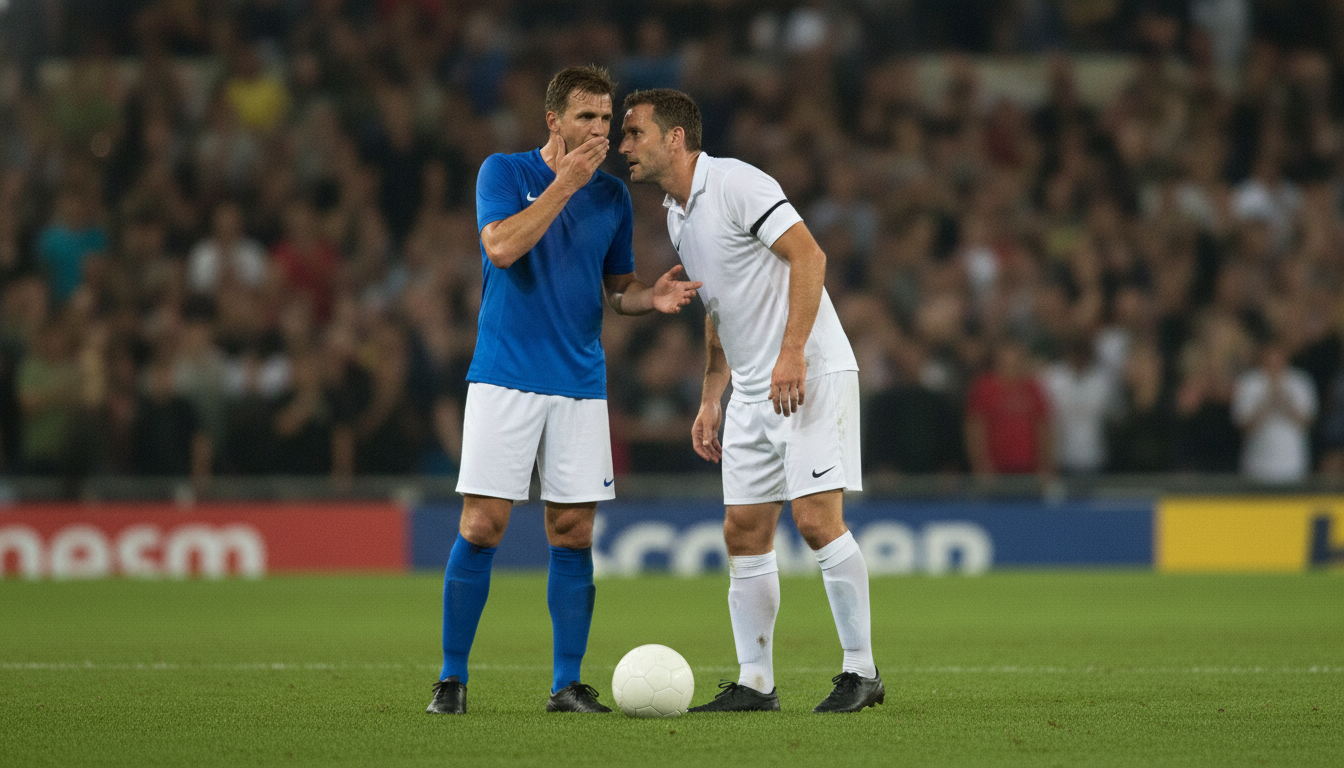
What does it mean when a footballer covers his mouth?
What does it mean when a footballer covers his mouth?
It looks like a small, almost bashful gesture, a hand cupped over the lips while two players stand close, heads together. It is nothing of the sort. It's a footballer making sure nobody outside that conversation gets to hear it.

Watch a corner being set up and you'll often see it: a defender leaning toward a teammate, hand raised to his mouth, muttering something before jogging back into position. Or watch two players squared up after a bad tackle, one of them shouting back with his hand across his lips as he does it. Same gesture, different reason, same goal, keep the words private.
Covering the mouth stops television cameras and lip-readers working out what's being said. Broadcasts zoom in constantly, and pundits and journalists have gotten good at reading lips off a slow-motion replay. A player who doesn't want his exact words printed the next morning has one simple defence: block the shot.
The most common flashpoint is confrontation. Arguments with opponents or with the referee can turn heated fast, and what gets said in the moment is often far saltier than a player would want repeated. Swearing at an official or hurling an insult at an opponent can lead to a booking or worse if it's clearly heard or clearly read off the lips afterwards. Covering the mouth while still getting the point across is a way of venting without leaving evidence.
The other big use is tactical. At corners and free kicks, teams often have rehearsed routines, a decoy run, a block, a specific starting position, and the instruction for who does what gets passed on in the seconds before the ball is delivered. If the opposition's video analysts have picked up on a team's habit of setting up certain deliveries, a lip-reader watching the replay could hand them a real advantage next time out. A hand over the mouth kills that off before it starts.
Not every instance is dramatic. Plenty of the time it's just a teammate cracking a joke, offering encouragement, or having a quiet dig at someone on the bench, and covering the mouth is just instinct, a private word should stay private, camera or no camera. There's no difference in the gesture itself between a player hiding a tactical instruction and one hiding a punchline; only the context tells you which it is.
What's worth being plain about is that none of this comes from anywhere official. It isn't a coaching method, it isn't a recognised signal system, and doing it or not doing it has no bearing on anything a referee cares about. It's simply a habit players have picked up because cameras are everywhere and lip-reading has become common enough that hiding your mouth is now the easiest way to keep a conversation off the record. Some players do it constantly, out of habit, even for the most harmless remarks; others never bother and let the cameras catch what they catch. That inconsistency is really the whole story, it's a personal precaution, not a shared code.

The day's football, in your inbox at 7 AM. Nothing else.
Pick of the night's matches, what the transfer window's doing, and the one column you should read today. No ads. No tips. No operators.
One-click unsubscribe. We do not share emails.
Comments
Loading comments…