
 BRE0
BRE0 TOT0
TOT0 ATH1
ATH1 SEV3
SEV3 EVE2
EVE2 CRY0
CRY0 IPS2
IPS2 SUN1
SUN1 NFO0
NFO0 LEE1
LEE1 HUL2
HUL2 MAN0
MAN0 ARS3
ARS3 COV0
COV0 BET1
BET1 RSO0
RSO0 BHA
BHA AVL
AVL MNC
MNC BOU
BOU NEW
NEW LIV
LIV VAL
VAL CEL
CEL ESP
ESP RMA
RMA ATM
ATM VIL
VIL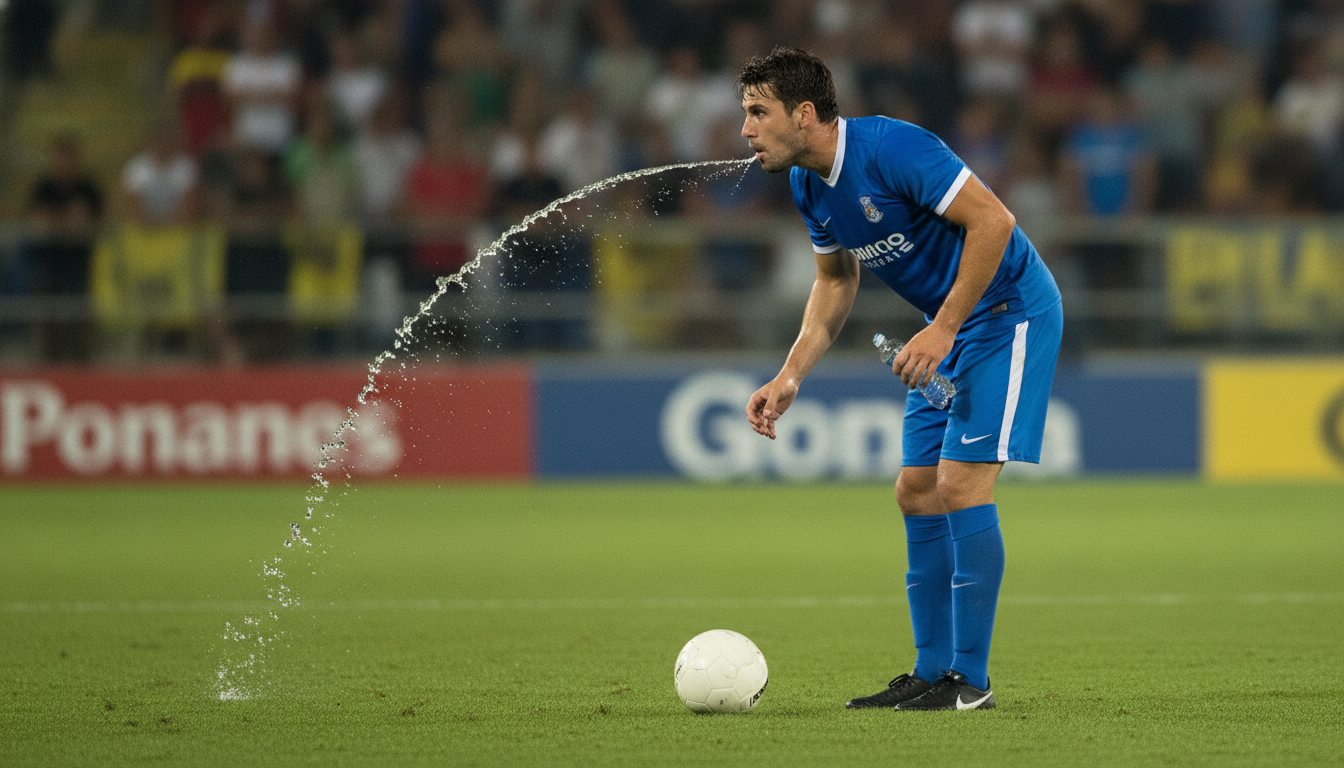
Why do football players spit water out?
Why do football players spit water out?
You've seen it a hundred times: a player grabs a bottle at a stoppage, takes a mouthful, and spits it straight onto the grass. It looks wasteful. It isn't.

A player jogs to the touchline during a break in play, squirts water into their mouth, swishes it around for a second or two, and then spits it out in a thin arc onto the pitch. They hand the bottle back and run off. Nothing is swallowed.
The short answer is that spitting the water out still works — and swallowing it can cause problems.
The mouth is lined with receptors that detect carbohydrates and water. When a player swishes a drink around, those receptors send a signal to the brain that fuel is on the way. The brain responds by reducing the feeling of fatigue and nudging the body to work harder. The player gets a real performance boost from the rinse alone, without a drop reaching the stomach. Sports scientists call this a mouth rinse, and it has been tested enough times to be taken seriously at professional level.
Swallowing, by contrast, carries a risk. During hard running, blood is pulled away from the gut and towards the working muscles. That makes digestion slow and unreliable. Taking on too much fluid mid-match can leave a player feeling heavy, bloated or, in worse cases, cramped. Spitting sidesteps all of that.
There is a second, simpler reason. Intense exercise dries the mouth out and leaves a stale, unpleasant taste. Players spit to clear it. The rinse freshens the mouth and makes breathing feel easier, even if the effect on performance is modest compared to the carbohydrate-receptor signal.
Not every player who spits is thinking about any of this. A fair number do it because they have always done it — because a senior player did it when they were coming through, because it is part of the rhythm of a water break, because it looks purposeful. Habit and imitation account for a portion of what you see on any given Saturday.
The drink in the bottle matters too. Plain water produces some of the mouth-rinse effect, but a carbohydrate solution — something sweet — produces a stronger one. Clubs that take the science seriously will often have players rinsing with a prepared carbohydrate drink rather than plain water, particularly in the second half when fatigue is building. Whether the player then spits or swallows often comes down to personal preference and how their stomach is feeling on the day.
So the gesture that looks like waste is, at least some of the time, a deliberate technique. The mouth does the work. The stomach stays out of it.


The day's football, in your inbox at 7 AM. Nothing else.
Pick of the night's matches, what the transfer window's doing, and the one column you should read today. No ads. No tips. No operators.
One-click unsubscribe. We do not share emails.
Comments
Loading comments…