
 DUR0
DUR0 STE0
STE0 ORL4
ORL4 RSO
RSO CEL
CEL MSU
MSU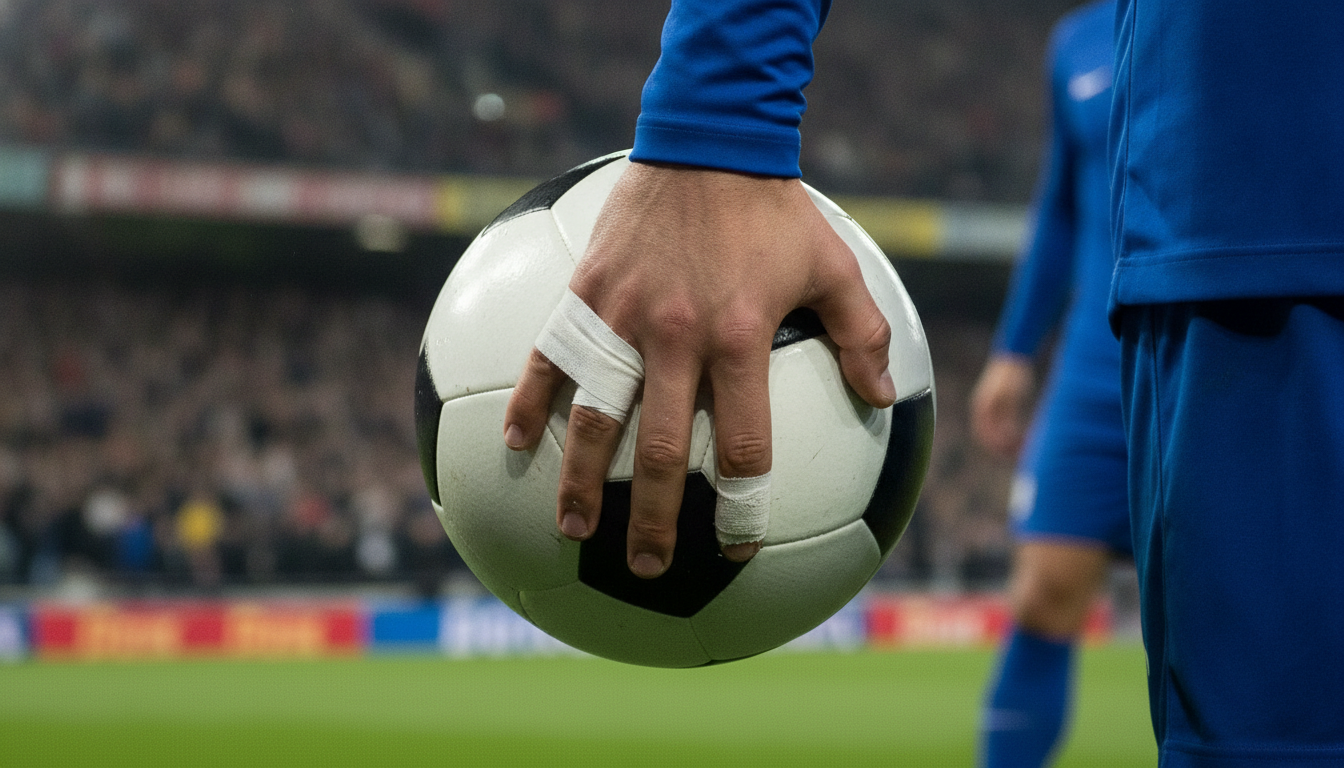
Why Do Football Players Tie Their Fingers Together?
Why Do Football Players Tie Their Fingers Together?
Look closely at a goalkeeper's hands during a match and you'll often spot two fingers bound together with strips of tape. It's not fashion, it's a makeshift splint.

Watch a goalkeeper collect a shot, then look down at his gloves before the next play. Two fingers, usually next to each other, are wrapped together with tape at the middle and top joints. Outfield players do it too, less often, a centre-back jogging back for a corner with his ring and little finger strapped as one unit.
This is called buddy taping. It means using a healthy finger as a support for an injured one by binding the two together, so the good finger stops the hurt one from bending or twisting the wrong way.
Players do it because a finger has been jammed, sprained, or dislocated, and taping it to its neighbour lets them carry on playing instead of coming off. The tape isn't decorative or for grip, it's doing the same job a small splint would do, just built from the player's own hand.
Goalkeepers do this the most, and it's easy to see why. Their fingers take direct impact from a hard, fast ball, over and over, across a match and across a season. A finger that gets bent backwards catching a shot, or takes a stud on top while punching clear, swells up and loses stability fast. Rather than strapping it in isolation, which a finger-sized splint would do clumsily inside a glove, taping it to the finger beside it keeps it aligned using the natural stiffness of the hand itself.
Outfield players buddy tape for a different reason, usually. A finger injured in a previous match, jammed diving for a challenge, caught awkwardly falling on the ball, twisted in a goalmouth scramble, hasn't fully healed, and taping it protects it from being knocked again during the next game.
The method works because the tape restricts movement without stopping it completely. A finger taped to its neighbour can still curl and flex roughly in step with the hand, so a goalkeeper can still grip and catch, and an outfield player can still control the ball. What the tape takes away is the finger's ability to bend sideways or hyperextend on its own, which is exactly the movement that causes a jam or a sprain in the first place. It's a compromise: not as protective as a rigid splint, but far less restrictive, which matters when the player needs full use of their hands within seconds of taping up.
The exception is anything more serious than a jam or sprain. A finger that's actually broken, or dislocated badly enough to need resetting, isn't something buddy taping fixes, it's a stopgap for players who can still function well enough to keep playing, not a treatment for a fracture. In those more serious cases, a player normally comes off rather than strapping up and continuing, because tape around two fingers offers support, not a cure.
The day's football, in your inbox at 7 AM. Nothing else.
Pick of the night's matches, what the transfer window's doing, and the one column you should read today. No ads. No tips. No operators.
One-click unsubscribe. We do not share emails.
Comments
Loading comments…