
 FUL1
FUL1 MAN1
MAN1 BOU0
BOU0 LIV1
LIV1 LEE0
LEE0 CRY0
CRY0 MNC5
MNC5 SUN3
SUN3 VAL2
VAL2 RSO3
RSO3 DEP1
DEP1 BET1
BET1 VIL3
VIL3 LEV1
LEV1 ATM2
ATM2 RMA1
RMA1 GET1
GET1 MCF0
MCF0 TSG0
TSG0 CHI1
CHI1 ARR0
ARR0 KAI0
KAI0 MAR0
MAR0 ORL2
ORL2 MIL1
MIL1 DUR1
DUR1 NCD
NCD SOL
SOL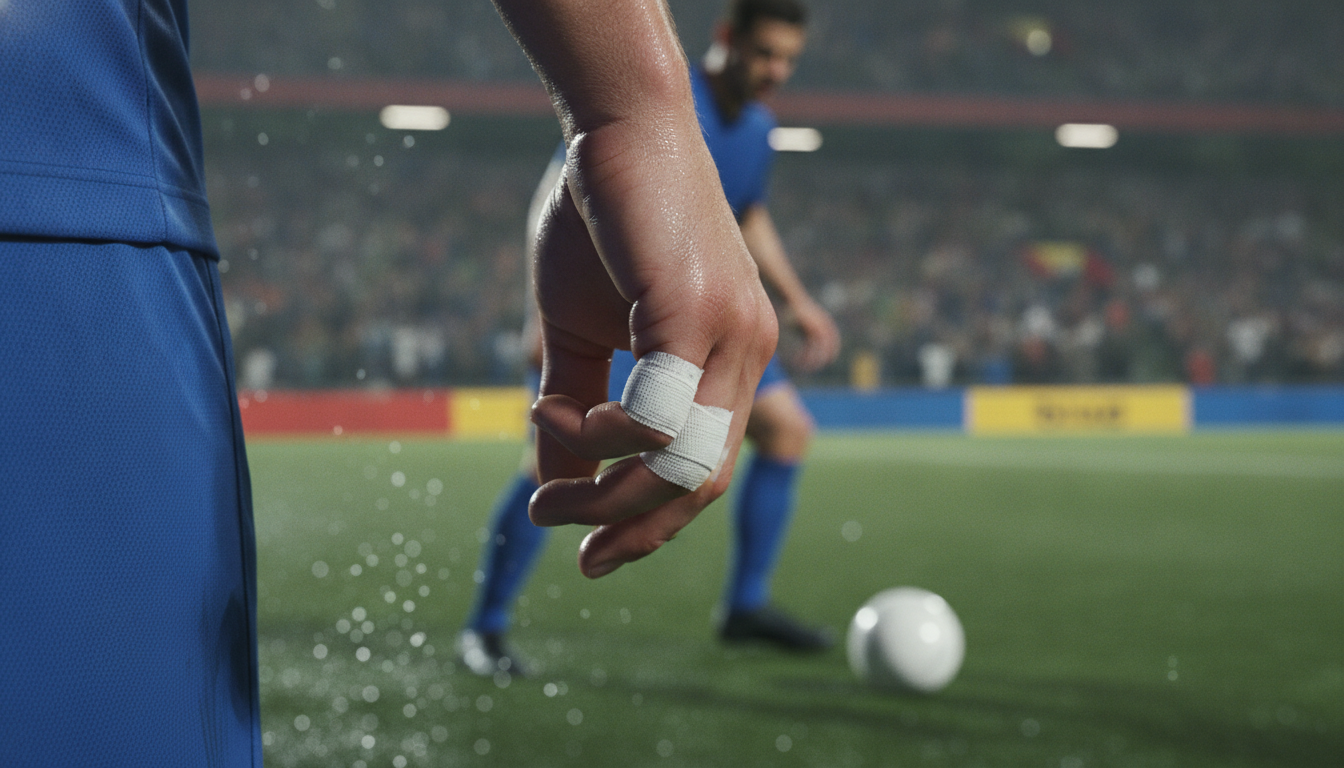
Why do footballers tie their fingers together?
Why do footballers tie their fingers together?
A goalkeeper punches clear at a corner, lands awkwardly on a hand, and jogs back into position with two fingers strapped together. It looks odd on camera. It is simple first aid.

The gesture itself is plain: one finger, usually the ring or little finger, taped snugly to the finger next to it. You see it most on goalkeepers, because their hands take the punishment, a shot straight onto an outstretched hand, a collision with a post, a finger bent back while punching a cross clear. But outfield players get it too, after a fall or a knock in a challenge.
The practice is called buddy taping. When a finger gets jammed, sprained, or partially dislocated, taping it to a healthy neighbour gives it something rigid to lean on. The uninjured finger acts like a splint. It cannot fix a break, but for the kind of finger injuries that happen constantly in a match, a joint wrenched sideways, a knuckle jarred by a ball travelling at speed, it does the job well enough to let someone keep playing rather than come off.
The tape works by restricting movement. A jammed or sprained finger is unstable at the joint; left alone, it can bend or twist the wrong way again with the next stray ball or grabbed shirt, making the injury worse. Binding it to its neighbour means the good finger's tendons and ligaments do the work of keeping both straight, so the hurt one cannot flex or rotate past a safe point. It is a support brace made out of another body part, essentially, no plaster, no rigid splint, nothing that would stop a goalkeeper gripping a ball or an outfield player controlling one.
Worth saying plainly: there is nothing symbolic in it. It is not a superstition, not a celebration, not a message to the referee or the crowd. It is treatment, applied by a physio at the touchline or in the changing room, for a very ordinary kind of injury that football produces in bulk, hands and fingers are exposed to impact constantly, whether that is a goalkeeper's palm meeting a shot or an outfielder's hand hitting the turf in a fall.
What catches people out is how long it can last. A single jammed finger from one match might mean tape for that game and the next, until the joint settles. But some players keep a finger strapped for weeks, sometimes across several matches, either because the injury is slow to heal or as pure precaution against knocking it again before it is fully sound. So the tape you notice on a player in October might have gone on after an incident from a fortnight before, not from anything that happened in the game you are watching. There is no single healing time attached to it, it stays on for as long as the finger needs support, and that varies from player to player and injury to injury.
The day's football, in your inbox at 7 AM. Nothing else.
Pick of the night's matches, what the transfer window's doing, and the one column you should read today. No ads. No tips. No operators.
One-click unsubscribe. We do not share emails.
Comments
Loading comments…