
 AZE1
AZE1 TJK0
TJK0 GIB0
GIB0 STP0
STP0 SOL
SOL VAN
VAN PNG
PNG NCD
NCD PLE
PLE NZL
NZL JPN
JPN URU
URU KOR
KOR ECU
ECU CHN
CHN MDV
MDV UZB
UZB IRN
IRN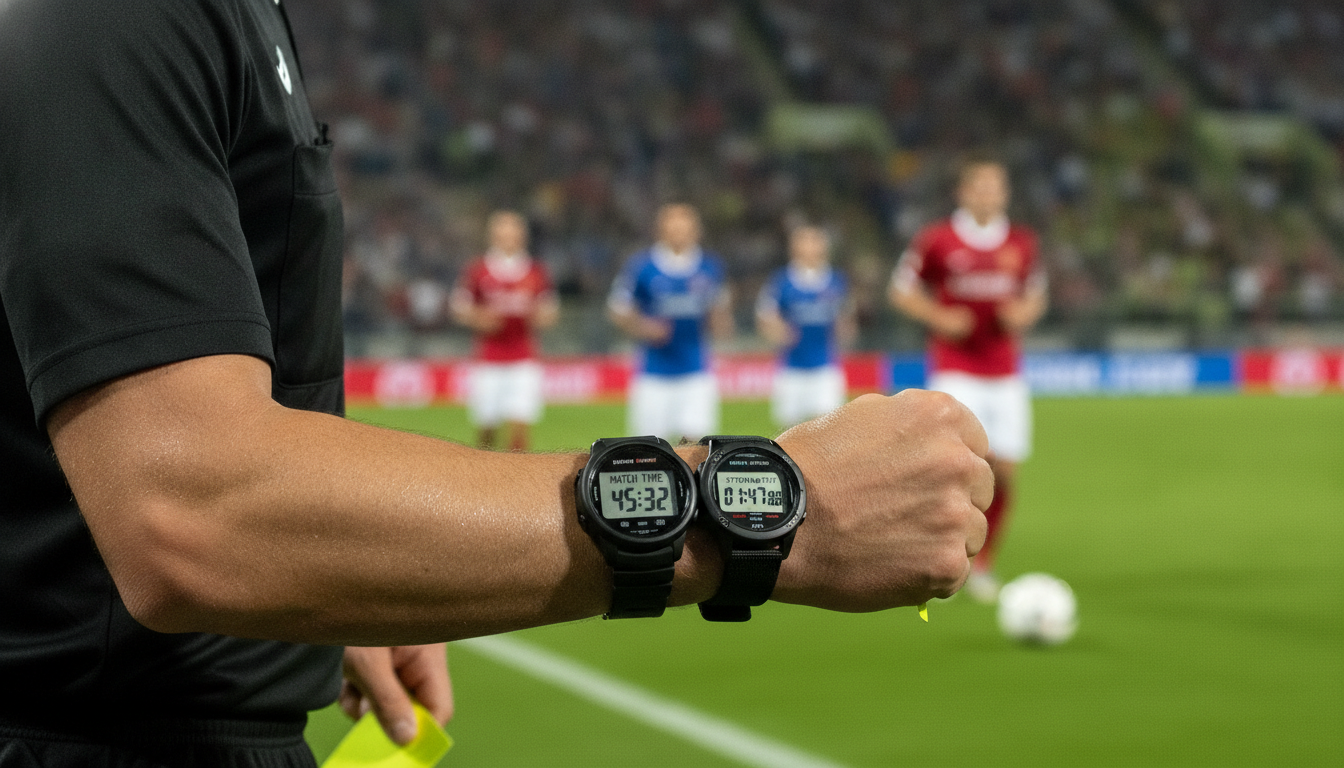
Why do referees wear 2 watches?
Why do referees wear 2 watches?
Look closely at a referee's wrist during a match and you'll spot two watches strapped side by side, not one.

Watch the referee's arm the next time there's a break in play, a player down injured, a substitution being made, a VAR check going on in the background. You'll see him press a button on one of the two watches on his wrist, then press it again once play restarts. The other watch never gets touched. It just keeps running from kickoff.
That's the whole answer. One watch counts the overall match time, ticking continuously from the first whistle. The second watch is used purely to time stoppages, the minutes lost to injuries, substitutions, goal celebrations, VAR reviews, anything that eats into playing time. The referee starts and stops that second watch each time play is interrupted, and adds up the total at the end of each half to work out how much time to add on.
This is why added time can look oddly specific, four minutes rather than a round three or five. It isn't a guess. It's built from a running tally of stoppages, timed separately on that second watch, then handed over as a number the fourth official holds up on the board.
The other reason is far less technical: it's a backup. Watches fail. Batteries die, straps snap, a watch gets knocked off a wrist in a collision or a goal celebration pile-on. A referee has no way to pause a football match while he finds a replacement or borrows one from a linesman. Wearing two from the start means that if one stops working mid-game, the match clock doesn't stop working with it. The referee still has a working watch on his other wrist and can carry on as if nothing happened.
So the two watches aren't doing the same job twice. One is the master clock for the match. One is a stopwatch for stoppages. And together they're also insurance against the ordinary, unglamorous risk of a piece of electronics failing at the worst possible moment. It's a small, practical habit rather than anything mandated in a dramatic way, the kind of thing a referee just does because it makes the job of tracking time properly, and covering for equipment failure, much easier.
The exception a lot of people miss: not every official needs two. Assistant referees and fourth officials don't run this same system, because the timing responsibility sits with the centre referee alone. It's specifically the person controlling the match clock who wears the pair, because he's the one whose watch failing would actually matter.

The day's football, in your inbox at 7 AM. Nothing else.
Pick of the night's matches, what the transfer window's doing, and the one column you should read today. No ads. No tips. No operators.
One-click unsubscribe. We do not share emails.
Comments
Loading comments…