
 DOR3
DOR3 VIL2
VIL2 FCP0
FCP0 MNC2
MNC2 LILL2
LILL2 BET3
BET3 RMA2
RMA2 INT1
INT1 AEK1
AEK1 LAS0
LAS0 BRU2
BRU2 AVL3
AVL3 BAR
BAR FEY
FEY VFB
VFB VIK
VIK LIV
LIV ATM
ATM NAP
NAP ARS
ARS PSG
PSG SLB
SLB SCP
SCP GAL
GAL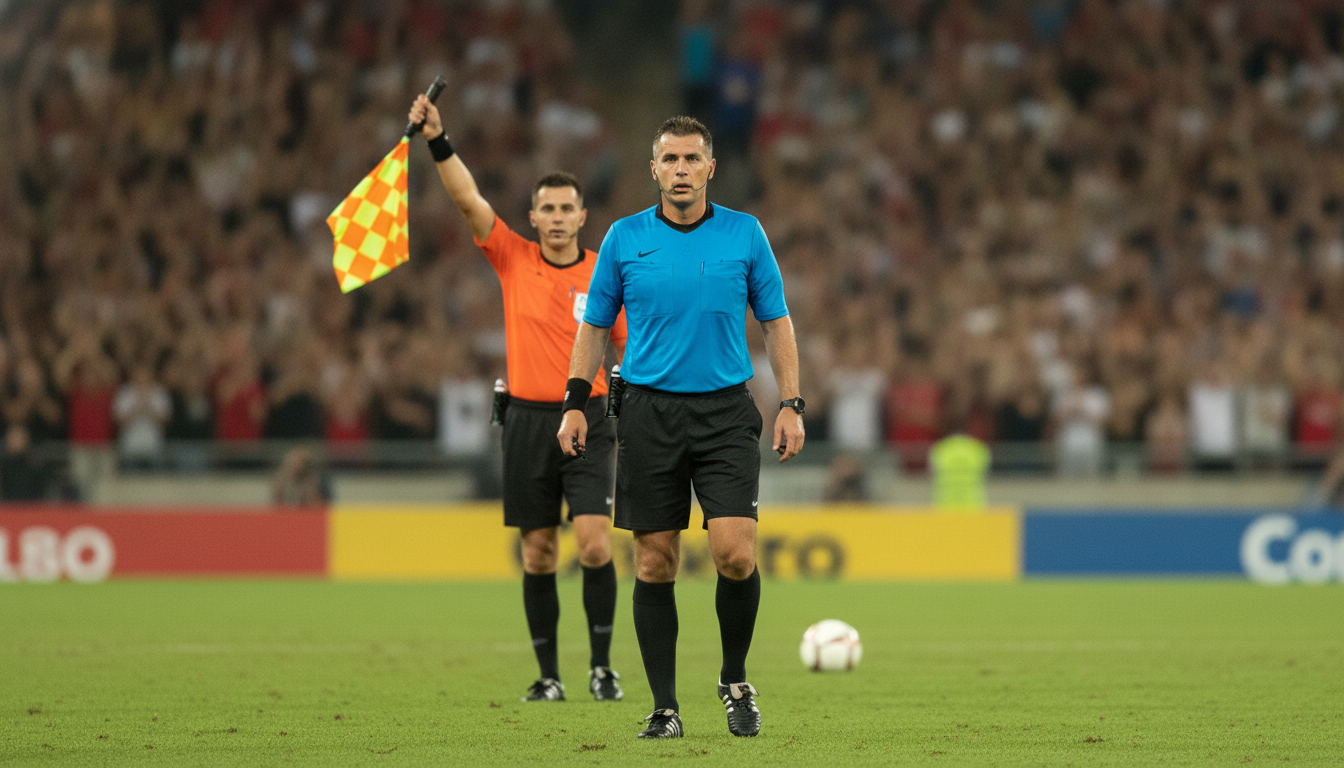
Why do referees wear black and white stripes?
Why do referees wear black and white stripes?
Picture a referee jogging along the touchline in a plain yellow shirt while the two teams run past in red and blue, no stripes in sight. That image is closer to the truth than the black-and-white one most people carry around in their heads.

Watch any match at the top level and you will see the referee in a single solid colour, black, yellow, red or blue, picked specifically for that game. There is no pattern, no stripe, just a block colour that sits apart from whatever the two teams are wearing. If both sides happen to be in dark shirts, the referee might switch to something bright. If one team is in yellow, the officials will avoid yellow that day. The whole point of the outfit is to make one figure on the pitch instantly readable as separate from everyone else running around it.
Most referees today simply don't wear black-and-white stripes. The stripes people picture belong to an older idea of what a referee looks like, one that has stuck in the popular imagination even as the actual kit has moved on. What referees wear now is chosen match by match for contrast, not tradition, a practical decision rather than a uniform in the old sense.
The logic is simple once you see it: a referee has to be spotted at a glance, by players making split-second decisions and by anyone watching from the stands or on a screen. A player deciding whether to pass, or an assistant checking an offside line, doesn't have time to squint and work out which of three figures in similar colours is the one with the whistle. A shirt that clashes with neither team solves that problem instantly. That's why the choice isn't fixed, it depends entirely on what the two teams are wearing that day, and a kit that works fine one weekend might be swapped out the next if the fixture calls for it.
The black-and-white stripe image isn't invented out of nowhere, though. Referees historically wore all-black kits, and that plain black look seems to be the root of the confusion, over time it's been misremembered, or blurred together with the idea of stripes, until the two got tangled up in people's memory of what officials look like. Black was itself chosen for visibility in its era, long before the idea of matching the shade to each specific fixture took hold.
Kit choice still comes down to what avoids a clash on any given day, which means the exact colour a referee wears can vary from one match to the next, even for the same official. There's no single "referee colour" the way there once effectively was with black. The one constant is the underlying reason: stand out, don't blend in, and make sure nobody on the pitch mistakes the referee for a player.



The day's football, in your inbox at 7 AM. Nothing else.
Pick of the night's matches, what the transfer window's doing, and the one column you should read today. No ads. No tips. No operators.
One-click unsubscribe. We do not share emails.
Comments
Loading comments…