
 ALB2
ALB2 SMR1
SMR1 BLR1
BLR1 FIN0
FIN0 CRO1
CRO1 ESP2
ESP2 ENG3
ENG3 CZE0
CZE0 EST0
EST0 ISL0
ISL0 LUX0
LUX0 BUL2
BUL2 MDA0
MDA0 SVK4
SVK4 SCO1
SCO1 SVN2
SVN2 SUI3
SUI3 MKD0
MKD0 KAZ2
KAZ2 FRO2
FRO2 MEX0
MEX0 CHI2
CHI2 USA1
USA1 CAN0
CAN0 COL2
COL2 PER0
PER0 ARG3
ARG3 BEN0
BEN0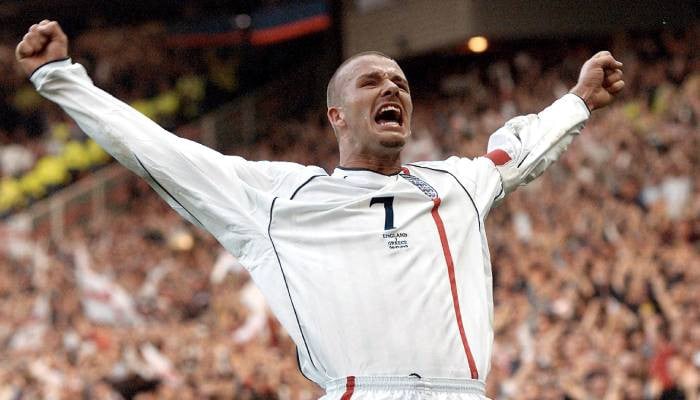
Photo: jang.com.pk
The free-kick that saved Beckham
Twenty-five years ago this October, David Beckham stood over a ball in stoppage time at Old Trafford with an entire country's patience running out, and put England into the 2002 World Cup with one swing of his right boot.
Written with AI and checked automatically before publishing. How we work
The scene nobody wanted to be in
England needed a win over Greece to finish top of their qualifying group. A draw would still send them through, courtesy of Germany failing to beat Finland elsewhere, but nobody in the stadium knew that at the time. All they knew was that England were 2-1 down deep into stoppage time, Beckham had missed chances all night, and the crowd's patience had worn to nothing.
Then, in the 93rd minute, he curled a free-kick from just outside the box over the Greek wall and into the top corner. England finished 2-2. They were going to Japan and South Korea.
The redemption nobody saw coming three years earlier
To understand why that goal mattered so much, you have to go back to 1998. Beckham was sent off against Argentina in the World Cup in France for a petulant kick on Diego Simeone, and England went out on penalties. He came home to effigies of himself burned outside pubs and a level of public hostility rarely aimed at an English footballer before or since.
He spent the following seasons rebuilding, quietly, through performances for Manchester United rather than apology. But the Greece free-kick was different: it was the moment the redemption became visible, televised, impossible to argue with. A man who three years earlier had been the most hated player in the country was now the one who had single-handedly dragged England to a World Cup.
Why a free-kick did what three years of good form couldn't
Performances in the league build trust slowly. A moment like this one rewrites the story instantly, because everyone is watching the same thing at the same time and there is no room for a different interpretation. Beckham had been captain since Kevin Keegan's resignation earlier that year, not long after the Argentina fallout had cooled, and that night gave the armband retroactive justification. It wasn't just a goal. It was proof the captaincy had been the right call.
Sven-Göran Eriksson, in his first qualifying campaign as England manager, inherited a Beckham who was still finding his feet as a leader. The Greece game let him build the next two years of his England project around a player the country had decided, almost overnight, it could trust again.
The longer shadow of one free-kick
The goal against Greece didn't erase 1998, and Beckham never pretended it did. What it did was give England fans a second image to hold alongside the red card: a captain standing over a dead ball with the whole campaign on his boot, delivering when it mattered most. That juxtaposition, villain and saviour inside three years, is what made the moment stick rather than just the quality of the strike itself.
Twenty-five years on, it's still the reference point whenever English football talks about redemption arcs. Not because the free-kick was technically flawless, though it was that too, but because of the precise moment it arrived and who it arrived for.
Did that free-kick permanently change how England fans saw Beckham?
Sources1 source
The Athletic — Football
We name and link every outlet this article draws on, and rewrite their reporting in our own words rather than reprinting it.

The day's football, in your inbox at 7 AM. Nothing else.
Pick of the night's matches, what the transfer window's doing, and the one column you should read today. No ads. No tips. No operators.
One-click unsubscribe. We do not share emails.
Comments
Loading comments…