
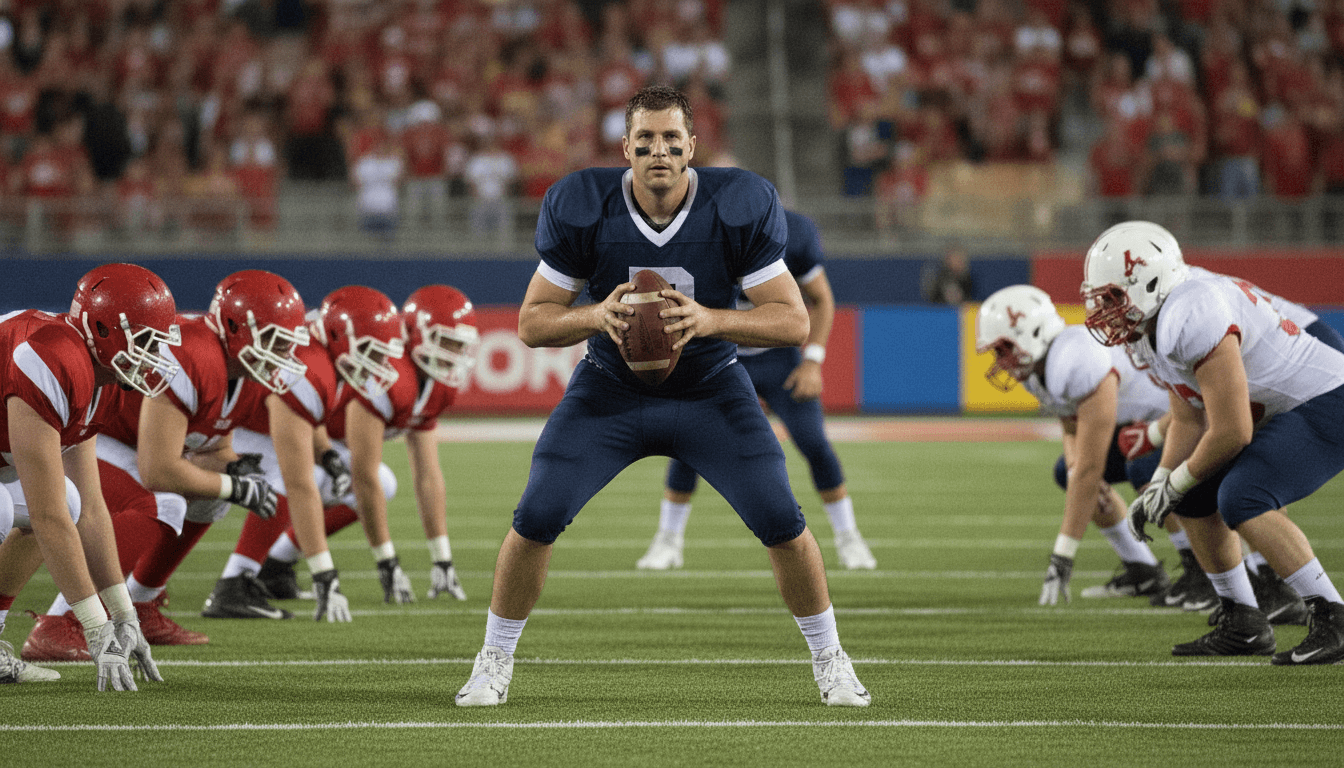
Why Is Football Called Football in America?
A kicker trots onto the field, swings his leg through a ball, and jogs off again, the one moment in an American football game that looks like what the name suggests. The rest of the sport is carried in hands and arms.
Written with AI and checked automatically before publishing. How we work
Picture a typical American football broadcast: a quarterback drops back and throws, a running back is tackled after a ten-yard gain, a receiver dives to catch a pass near the sideline. Feet barely touch the ball. Then, a handful of times a game, a specialist jogs out alone, the defense backs off, and he kicks the ball, a kickoff to start a half, a punt to flip field position, a field goal attempt through the uprights. That image, the kicking specialist standing apart from the rest of the game, is usually the thing people point to when they try to explain the name.
But that is not actually why it is called football. The word comes from where the game started, not from what the players do with their feet once it got there. In 19th-century Britain, 'football' was the umbrella term for a whole family of games played on foot, as opposed to games played on horseback like polo. Rugby football and association football both carried the name, and so did the rougher, more chaotic school and street games that sat somewhere between the two. None of those early versions were defined by kicking alone, carrying, throwing and shoving the ball around were all part of the mix depending on which version you were playing.
American football grew directly out of that messy 19th-century family, mostly out of the rugby-style games played at East Coast colleges. As the American version developed its own rules, the forward pass, the line of scrimmage, blocking, it kept the original name it had inherited, because at the time there was no reason to think 'football' meant anything narrower than 'a game you play on foot.' The sport changed almost beyond recognition over the following decades. The word did not need to.
Meanwhile, back in Britain, the word's meaning narrowed. As association football became the dominant code and rugby split off with its own identity, 'football' on its own came to mean specifically the kicking game, what Americans call soccer. British English picked one sport out of the old umbrella term and gave it the plain name. American English never went through that narrowing, because the sport it was shaping didn't need to be distinguished from a rival football code in the same way, rugby and soccer weren't competing for the word there the way they were in Britain.
So the two countries didn't disagree about what to call a kicking game. They inherited the same broad word from the same source and then let it settle into different shapes. Kicking still matters in the American sport, field position swings on a good punt, and tight games are decided by field goals, which is why the kicking explanation feels so plausible. It's just not the reason the name stuck. The name stuck because 'football' was never really about the foot touching the ball in the first place. It was about the foot touching the ground.




The day's football, in your inbox at 7 AM. Nothing else.
Pick of the night's matches, what the transfer window's doing, and the one column you should read today. No ads. No tips. No operators.
One-click unsubscribe. We do not share emails.
Comments
Loading comments…