
 VIE1
VIE1 THA1
THA1 BODO3
BODO3 NEC0
NEC0 LAS5
LAS5 CEL1
CEL1 HBE2
HBE2 VAL0
VAL0 BET1
BET1 AEK
AEK LEVS
LEVS LYON
LYON FEN
FEN NKC
NKC SLB
SLB VIK
VIK DZG
DZG ARA
ARA UCRA
UCRA IBE
IBE JAG
JAG BES
BES LIL
LIL OMON
OMON STVV
STVV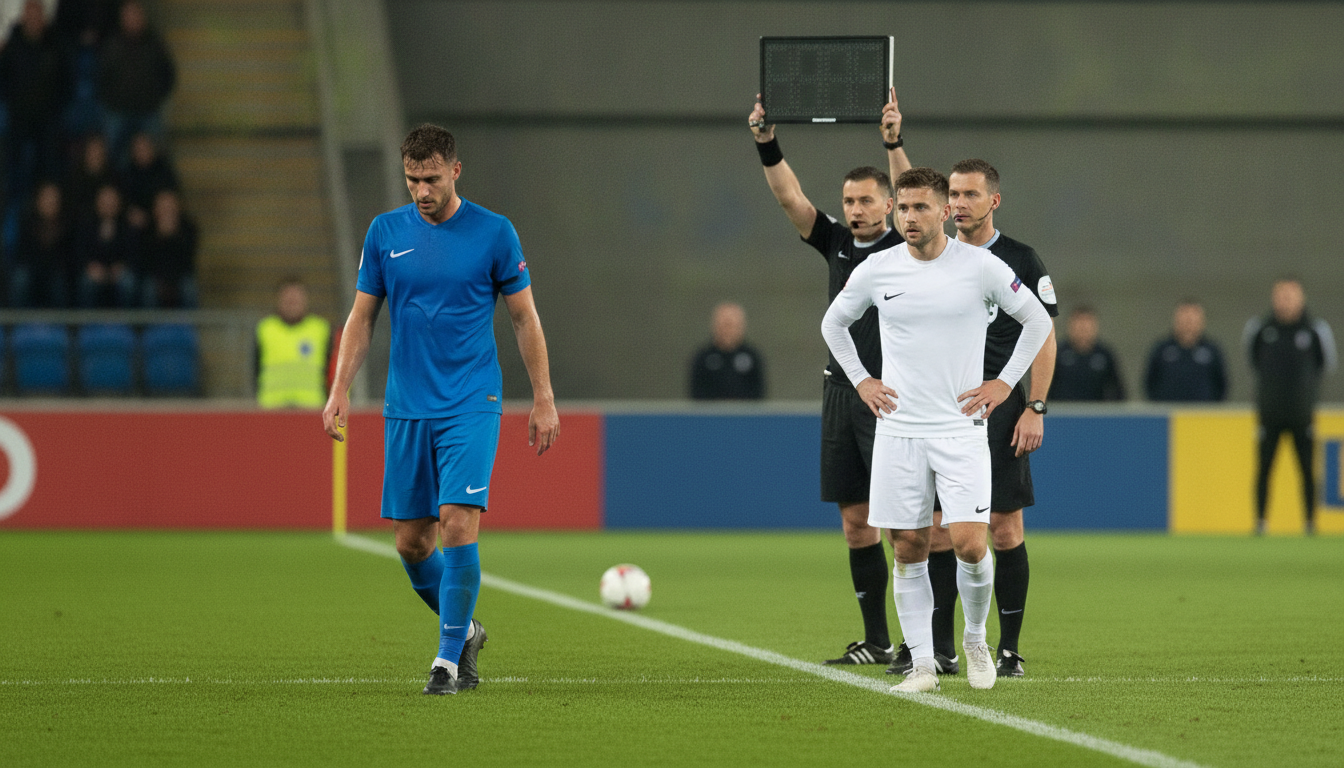
Can a football player be substituted twice?
Can a football player be substituted twice?
A player comes off in the first half, their team concedes, and you wonder: could they just bring him back on? The short answer is no — and the rulebook is unusually blunt about it.

Picture a winger trudging toward the touchline in the 60th minute, peeling off his bib, dropping onto the bench. His night is over. Not paused, not interrupted — over. That is the moment Law 3 is describing, and it leaves no room for a change of mind.
The rule is final. A substituted player cannot return to the field in a standard match, full stop.
The IFAB Laws of the Game — Law 3: The Players — puts it this way: the substituted player "must go immediately to the technical area or dressing room and takes no further part in the match, except where return substitutions are permitted." That phrase at the end sounds like a loophole, but the follow-up sentence closes it almost immediately. "The use of return substitutions is only permitted in youth, veterans, disability and grassroots football, subject to the agreement of the national football association, confederation or FIFA."
So at any professional or senior amateur level — your top-flight league, your cup final, your Sunday open-age league that runs under standard rules — a substituted player is done. The manager cannot change his mind. An injury to the replacement does not bring the original player back. Nothing does.
The law reinforces this in another way that most fans never notice. If a player is sent off after already being substituted — say, they react badly to a decision from the bench — their team cannot replace them. The sending-off costs the team a body, but the substituted player still does not come back on. The finality of the substitution holds even in that situation.
The logic behind it is straightforward. Substitutions are a tactical tool, and the rules treat the decision as binding the moment it is made. Allowing a manager to reverse a substitution would effectively give them extra goes — a player could come off for a rest, then return when the game situation changed. The rule prevents that.
The exception carved out for youth, veterans, disability and grassroots football exists for welfare and practical reasons. Younger players benefit from getting game time without being permanently removed; smaller squads in grassroots settings may not have enough bodies to absorb injuries cleanly. But those competitions have to specifically adopt return substitutions — they are not on by default even there. A national association, confederation or FIFA has to agree to them first.
For anyone watching a professional match, the picture is simpler: the player who walks off does not walk back on.
Nguồn1 nguồn
IFAB Laws of the Game — Law 3: The Players, IFAB Laws of the Game — Law 3: The Players
Biên tập viên của Flagside đọc từng bài trước khi đăng. Chúng tôi khai thác báo chí bóng đá, tự viết nội dung thay vì đăng lại của người khác, và kiểm tra độ chính xác cũng như nguồn tin cho mỗi bài. Mọi tờ báo góp phần vào bài viết này đều được ghi rõ trong phần Nguồn.

Bóng đá trong ngày, vào hộp thư lúc 7 giờ sáng. Không gì khác.
Điểm nhấn trận đêm qua, cửa sổ chuyển nhượng đang diễn ra thế nào, và một bài đọc không thể bỏ qua hôm nay. Không quảng cáo. Không tips. Không nhà cái.
Hủy một cú click. Chúng tôi không chia sẻ email.
Comments
Loading comments…