
Why Do Footballers Wear Masks?
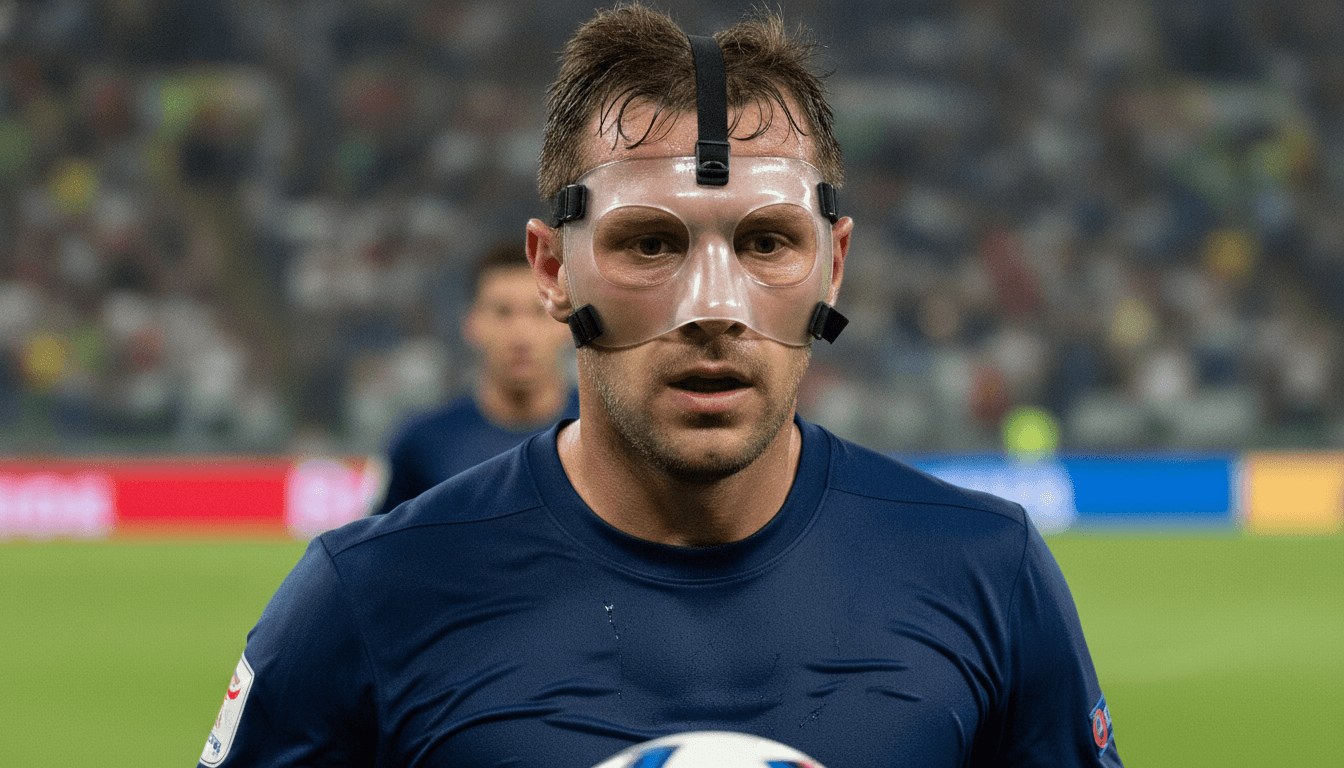
A player jogs out for the warm-up with a black or clear shield covering half his face, strapped on like something from a different sport. It looks alarming. It is usually just a broken bone, and a short-term fix.
Written with AI and checked automatically before publishing. How we work
Picture the scene: a striker goes up for a header, takes an elbow or a boot to the face, and comes away with blood streaming and a nose bent the wrong way. A few weeks later he is back on the pitch, same competitive edge, except now there is a hard shell strapped across his nose and cheeks. That shell is a protective mask, and it is there because the bone underneath has not finished healing.
The mask exists to let a player keep playing through an injury that would otherwise keep him out. The usual culprits are a broken nose, a fractured cheekbone, or damage around the eye socket, all common results of the kind of aerial collisions that happen dozens of times a match. Rather than sit out the weeks it takes bone to mend fully, a player can have a mask made and get back on the pitch far sooner, with the injury shielded from further contact.
These masks are not bought off a shelf. Each one is custom-moulded to the individual player's face, usually from carbon fibre or a rigid plastic, chosen because both materials are light enough not to slow him down but stiff enough to absorb a knock that would otherwise land directly on the fracture. Some are made in black, some in clear plastic that barely shows on television, but the shape and fit are always specific to the player wearing it, a generic mask would either not protect the right spot or would be too loose to stay in place during a sprint or a header.
The mask does not speed up healing. It simply stands between the fracture and the next collision while the bone knits back together underneath. That is why the timeline for wearing one tends to track the injury itself rather than any fixed rule, a few weeks is typical, roughly the time it takes the kind of facial fractures players pick up to become stable enough to withstand normal contact again.
What surprises people is that players often keep wearing the mask well after the pain has gone and the bone feels fine. That is not stubbornness or superstition, it is simple caution. A healed fracture is still a weaker point than the surrounding bone for some time afterward, and a second knock in the same spot can undo weeks of recovery. So a player and his medical staff will often agree to keep the mask on for a stretch of games purely as insurance, even once he says he feels nothing when he presses on it himself.
There is no governing requirement forcing any of this, a player could, if he and his club judged it safe, simply skip the mask and play bare-faced once symptoms ease. The mask is a medical and practical choice, not an obligation, which is why some players discard theirs the moment it starts to feel like more hindrance than help, while others wear it until the final whistle of a long run of matches just to be sure.


The day's football, in your inbox at 7 AM. Nothing else.
Pick of the night's matches, what the transfer window's doing, and the one column you should read today. No ads. No tips. No operators.
One-click unsubscribe. We do not share emails.
Comments
Loading comments…