
Why Do Referees Wear Two Watches?
Look closely at a referee's wrists during a match and you'll often spot two watches stacked side by side, not one. They're doing two completely different jobs.
Written with AI and checked automatically before publishing. How we work
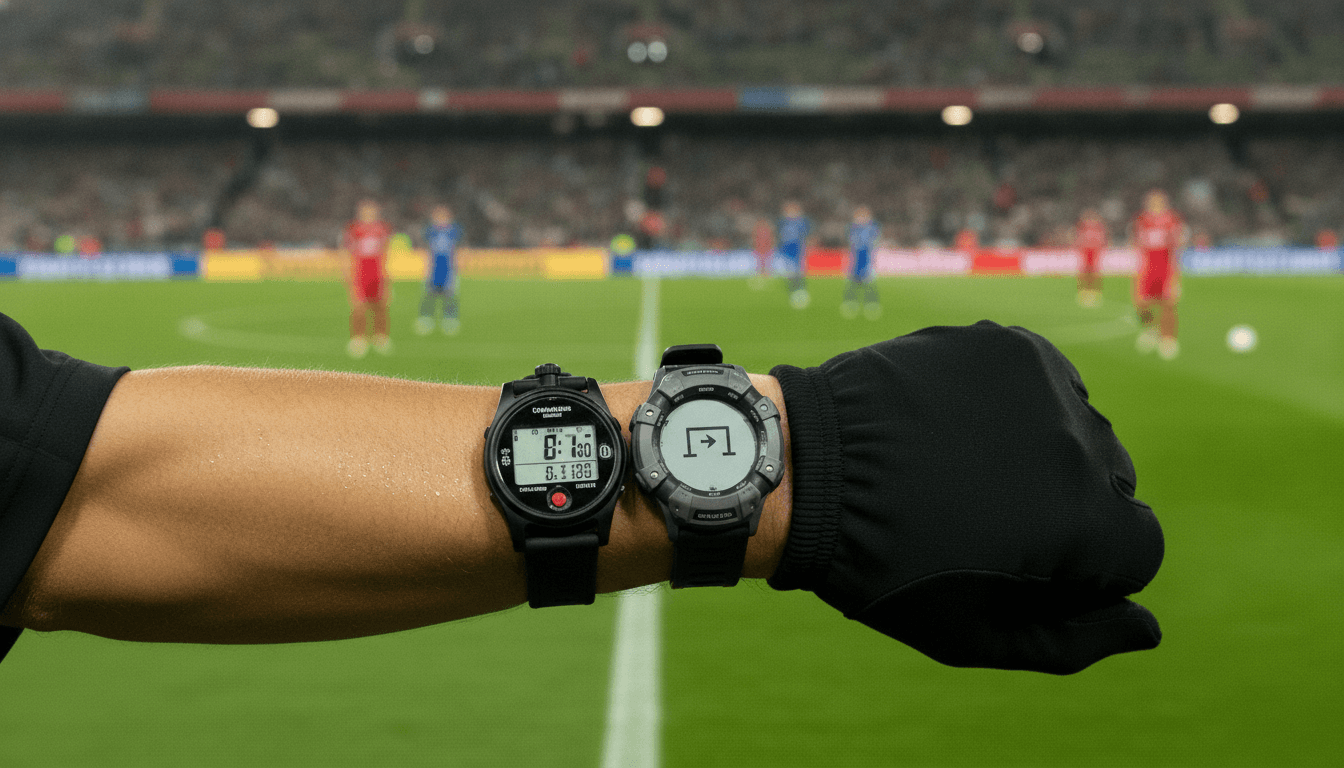
Watch a referee jog back to the centre circle after a goal and glance at his wrist before pointing to the spot. You'll see it then: two watches, usually one on top of the other, both black, both chunky. It looks like overkill. It isn't.
One of those watches is a plain stopwatch. The referee starts it at kickoff, and it's what he uses to track how long the half has run and how much stoppage time needs adding on for substitutions, injuries and time-wasting. It's manual, he presses it himself when the ball goes out or when he blows for a break in play, and presses it again when he restarts the clock. All the maths about how many minutes to add at the end comes from this one watch and the referee's own running count.
The second watch isn't a timepiece in the normal sense. It's a receiver linked to the goal-line technology system inside the stadium. Sensors around the goal track the ball, and the moment it fully crosses the line, that watch buzzes and flashes up the word GOAL. It's essentially a hyper-fast text message from the technology to the referee's wrist, cutting out any need to check with a linesman or wait for a video replay screen. The referee feels the vibration and makes the call instantly.
The reason for splitting these two functions across separate devices rather than cramming them into one gadget comes down to reliability. If a single watch had to run the match clock, manage stoppage time and also receive goal-line signals, a malfunction or a mis-press would take out the whole system at once. Two separate watches mean two separate points of failure. If the stopwatch is knocked, set wrong, or simply stops working, the goal-line watch is unaffected and keeps doing its job, and the other way round too. It's a backup built into the kit itself rather than something the referee has to think about.
The exception worth knowing is that the goal-line watch is completely useless at grounds that don't have the goal-line technology installed in the first place. Plenty of matches, right down through the leagues and even in some top-flight fixtures depending on the competition and stadium, are played without that sensor system in the goalposts at all. In those games a referee might still wear two watches out of habit, or simply wear one, because there's no goal-line signal to receive. The stopwatch for timing the match, on the other hand, is needed in every single game regardless of what technology the stadium has, which is why it's the one constant on a referee's wrist from the lowest park pitch to the biggest cup final.




The day's football, in your inbox at 7 AM. Nothing else.
Pick of the night's matches, what the transfer window's doing, and the one column you should read today. No ads. No tips. No operators.
One-click unsubscribe. We do not share emails.
Comments
Loading comments…