
 MNC4
MNC4 ARS2
ARS2 AVL1
AVL1 CRY1
CRY1 BHA5
BHA5 CHA1
CHA1 EVE2
EVE2 BIR1
BIR1 TOT1
TOT1 LCL6
LCL6 WHU0
WHU0 CHE3
CHE3 BIH1
BIH1 POL0
POL0 FRA4
FRA4 BEL1
BEL1 ITA3
ITA3 TUR1
TUR1 MNE0
MNE0 ARM0
ARM0 NIR0
NIR0 GEO0
GEO0 ROU0
ROU0 SWE1
SWE1 UKR1
UKR1 HUN2
HUN2 CYP2
CYP2 LVA1
LVA1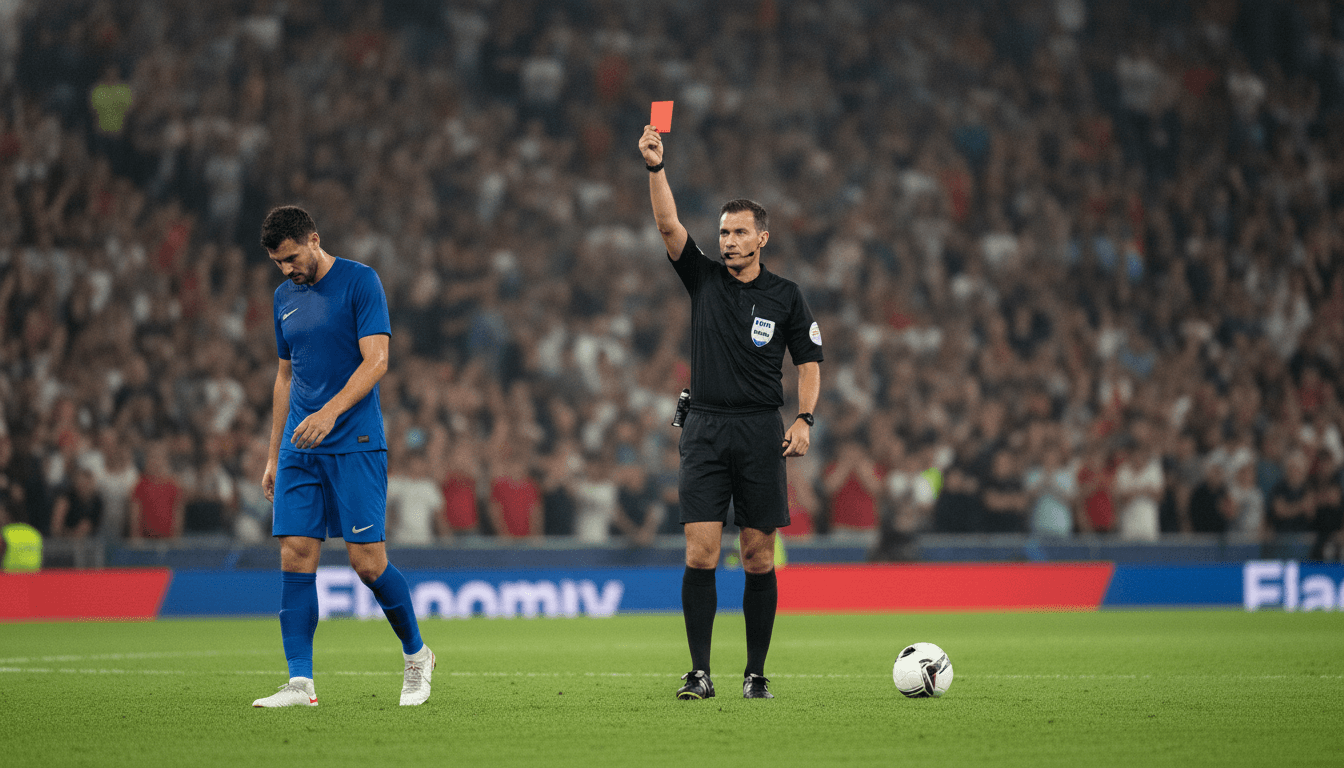
Do Footballers Get Fined for Red Cards?
A player sees red, trudges off alone past the bench, and the manager turns away without a word. The punishment that follows isn't usually a bill, it's a ban.
Written with AI and checked automatically before publishing. How we work
Picture the moment: a reckless tackle, the referee's arm shoots up, and the player walks the long way round the pitch to the tunnel while team-mates avoid eye contact. Within a day or two, a letter or a notice tells him how many matches he'll miss. That's the punishment people actually see play out, not a fine, a suspension.
The straightforward answer is no, there is no automatic fine for getting a red card. The standard consequence is a ban of one or more games, decided by the severity of the offence. A reckless lunge might cost one match. Serious foul play or violent conduct can cost several. Money doesn't come into the official process at all.
That said, plenty of fans assume a fine must follow, because clubs sometimes do make an example of a player internally. A manager embarrassed by a red card, especially one that costs the team a man for 70 minutes of a must-win game, can dock wages or hand out an internal disciplinary fine as a separate, private punishment. This has nothing to do with the official sanction; it's the club protecting its own standards, and it varies wildly from one dressing room to another. Some clubs do it routinely, others never bother, and players rarely talk about it publicly.
Why is a ban the default rather than a fine? Because the whole point of sending a player off is to remove him from the game he's disrupted, and the follow-up punishment extends that logic forward, he sits out future games too, which hurts a professional far more than a one-off financial penalty would. A missed match affects form, fitness, and a place in the side. A fine, for a Premier League or Championship earner, barely registers. Suspension is the punishment that actually bites.
The exception worth knowing is that disciplinary bodies, in England, the FA is the relevant one, can step in with an additional fine on top of the ban, but only in serious cases. Violent conduct, particularly incidents caught on camera that go beyond what the referee initially saw, can trigger a retrospective charge, and a fine sometimes comes bundled with an extended ban. These cases are rare. They're reserved for the nastiest incidents, not for a mistimed tackle or a second yellow for shirt-pulling. For the vast majority of red cards, the clumsy ones, the hot-headed ones, the professional fouls, the only cost is time out of the team, not money out of the pocket.
So the next time a player trudges off with his head down, the thing to watch for isn't a fine notice, it's the team sheet for the next few matches, where his name simply won't appear.


The day's football, in your inbox at 7 AM. Nothing else.
Pick of the night's matches, what the transfer window's doing, and the one column you should read today. No ads. No tips. No operators.
One-click unsubscribe. We do not share emails.
Comments
Loading comments…