

What happens if a football match is a draw?
Two teams finish level on the scoreboard, the whistle goes, and nothing more happens on the pitch that day, but what the draw actually costs or earns each side depends entirely on what kind of match it was.
Written with AI and checked automatically before publishing. How we work
Picture a Saturday afternoon league fixture, 1-1 at full time, players shaking hands and walking straight down the tunnel. No extra time, no penalties, nothing. The referee blows for ninety minutes plus stoppage time, the scoreline stands, and that's the match done.
In league football, that's exactly what happens: the draw is the final result. Each team collects 1 point for drawing, compared with 3 for a win and 0 for a loss. Nobody is declared the winner. The two clubs simply add that single point to their tally and move on to the next fixture. A 0-0 counts exactly the same as a 4-4 for these purposes, both sides scored the same number of goals, so both get the same reward.
A cup tie is a different picture entirely. Imagine the same 1-1 scoreline, but this time it's a Champions League knockout leg or an FA Cup tie, and someone has to go through to the next round. The players don't leave the pitch. They regroup, drink some water, and play an additional period of extra time, usually two halves of fifteen minutes each. If somebody scores in that spell, the match often still runs its full length rather than ending the instant a goal goes in, and whoever is ahead when the extra time finishes goes through.
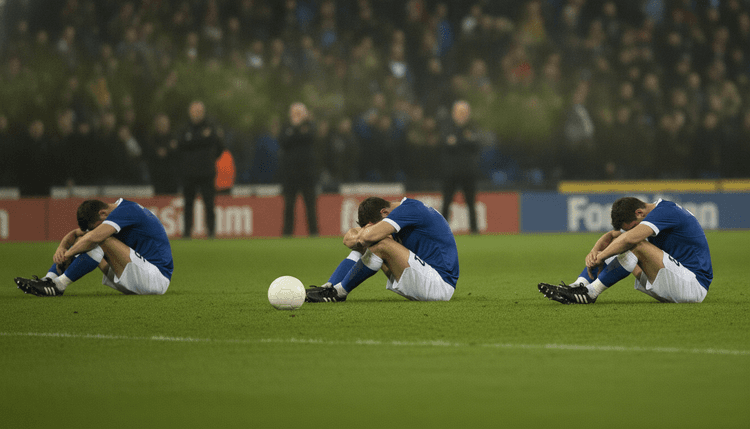
If the score is still level after extra time, the match is settled by a penalty shootout. Players from each side step up one at a time to take spot-kicks, and the team that scores more penalties advances. This is the scene most people picture when they think of a dramatic cup exit, a goalkeeper diving the right way at last, a player walking back to the halfway line with his head down, team-mates either sprinting to celebrate or standing frozen near the centre circle.
There's an older method that still survives in parts of the game, mostly in earlier or lower rounds of some domestic cups: the replay. Instead of extra time and penalties on the same night, the two teams simply play the whole match again, often at the other team's ground a week or so later. If that second match also ends level, it then typically goes to extra time and penalties to force a result, since a competition can't keep scheduling replays indefinitely.
So the honest answer is that there's no single thing that happens when a football match is drawn, it depends entirely on what the draw is for. A league table has no trouble with an unresolved scoreline; it just hands out a point each and waits for the next round of fixtures. A knockout competition has no such patience, because someone has to carry on to the next stage, so it keeps extending the contest, extra time, penalties, sometimes a whole replayed match, until one team is left standing.


The day's football, in your inbox at 7 AM. Nothing else.
Pick of the night's matches, what the transfer window's doing, and the one column you should read today. No ads. No tips. No operators.
One-click unsubscribe. We do not share emails.
Comments
Loading comments…