
Why do football players wear padded helmets?
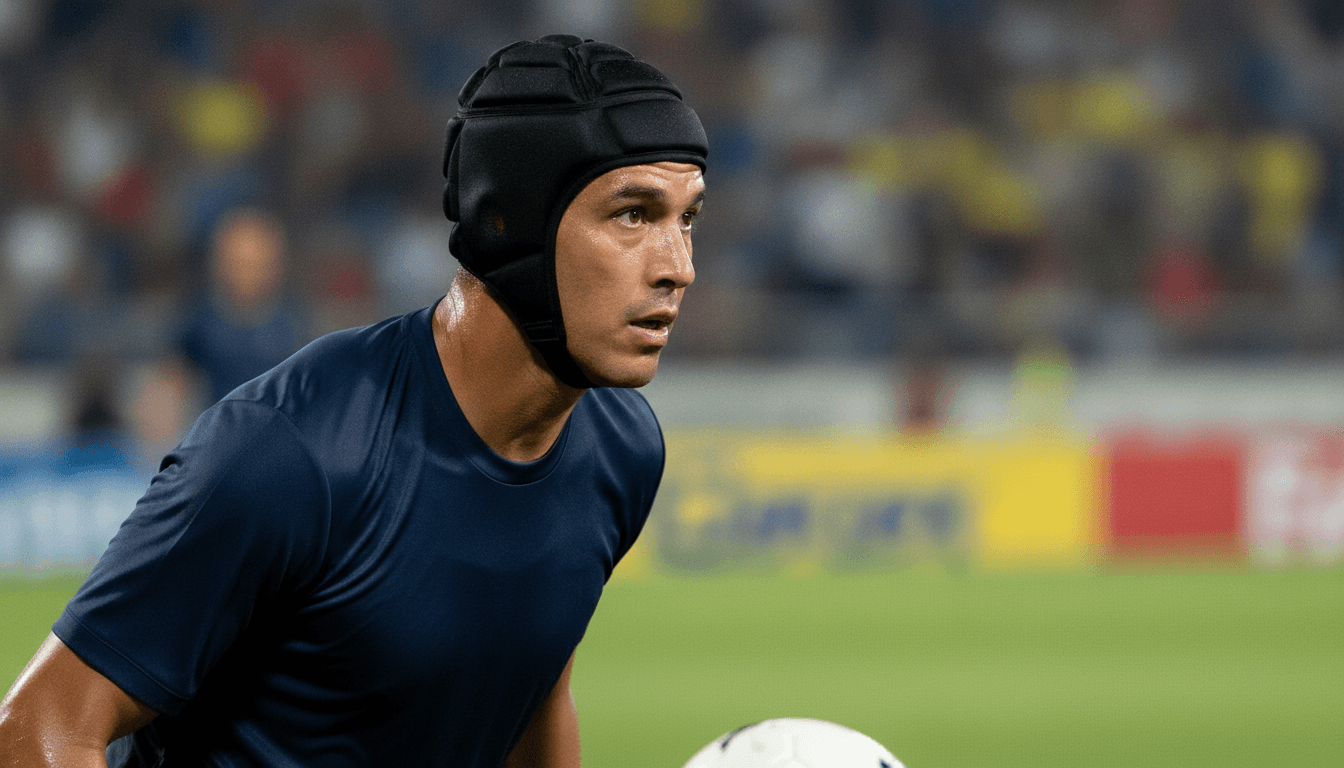
A goalkeeper comes out for a corner with a thin strip of padding wrapped around his head, dark fabric covering his hairline from ear to ear. It looks almost like a cycling cap gone wrong. Here's what it's actually for.
Written with AI and checked automatically before publishing. How we work
The padding is soft, not a rigid shell like a motorbike helmet. It sits close to the skull, usually under a bit of elastic or a chinstrap, and from a distance it can be mistaken for a sweatband. Players who wear it are almost always goalkeepers, since they're the ones most likely to collide with posts, crossbars, opponents' knees and the ground while diving for a ball.
The reason is simple: the player has had a serious head injury in the past, often a fracture, and the padding is there to cushion the area while it heals or to lower the risk of it being struck again. One well-known case is a goalkeeper who fractured his skull in a collision and then wore the padded headgear for the rest of his playing career, long after the original injury had healed.
There's no rule that says a player has to wear it, and no competition hands it out as mandatory kit. It's a personal decision, usually made after talking to club doctors or medical staff, weighing up how much protection it realistically offers against how comfortable the player feels going back into contact situations. Some choose it after one specific injury and never take it off again. Others wear it simply as a precaution, having had enough near misses in training or matches to want a bit of extra cushioning before anything serious happens.
What the padding does not do is prevent concussion. It softens the blow from a direct impact, reducing cuts, bruising, and some of the shock to a bone that's already been broken once, but it can't stop the brain moving inside the skull on a hard knock, which is what causes a concussion. Medically, it's a modest layer of protection rather than a shield. Anyone expecting it to make a goalkeeper collision-proof is expecting too much from a few millimetres of foam.
That gap between what it looks like it should do and what it actually does is probably why the padding has stayed rare. It solves one problem, protecting a healing fracture, or cushioning a specific vulnerable spot, without solving the bigger one that worries medical staff most, which is head trauma from any direction. A player who has broken his skull once has a very good reason to want some kind of barrier there. A player who hasn't had that injury has far less incentive to wear something that limits vision and comfort for a benefit that's, by the manufacturers' and doctors' own admission, limited.
The exception worth knowing is that the padding isn't only reactive. Not every player wearing it has a fracture history. Some put it on as a precaution after a string of close calls, deciding the small discomfort is worth it even without a specific injury forcing the issue. That's a judgement call between player and medical staff, not something imposed from outside, and it's why you'll see it on some goalkeepers with long, injury-free careers and not on others who've had similar knocks.


The day's football, in your inbox at 7 AM. Nothing else.
Pick of the night's matches, what the transfer window's doing, and the one column you should read today. No ads. No tips. No operators.
One-click unsubscribe. We do not share emails.
Comments
Loading comments…