
 BRC0
BRC0 BLK1
BLK1 BUR2
BUR2 CHA1
CHA1 CAR4
CAR4 WAT0
WAT0 MIL0
MIL0 SWA0
SWA0 WOL1
WOL1 BOL2
BOL2 WXM1
WXM1 WBA1
WBA1 BIR3
BIR3 PNE0
PNE0 STK1
STK1 MID1
MID1 ARS1
ARS1 LILL0
LILL0 ATM1
ATM1 MAN0
MAN0 GAL1
GAL1 BAR3
BAR3 INT1
INT1 BRU2
BRU2 RBL0
RBL0 PSV0
PSV0 VIK2
VIK2 MUN2
MUN2 VIL2
VIL2 NAP1
NAP1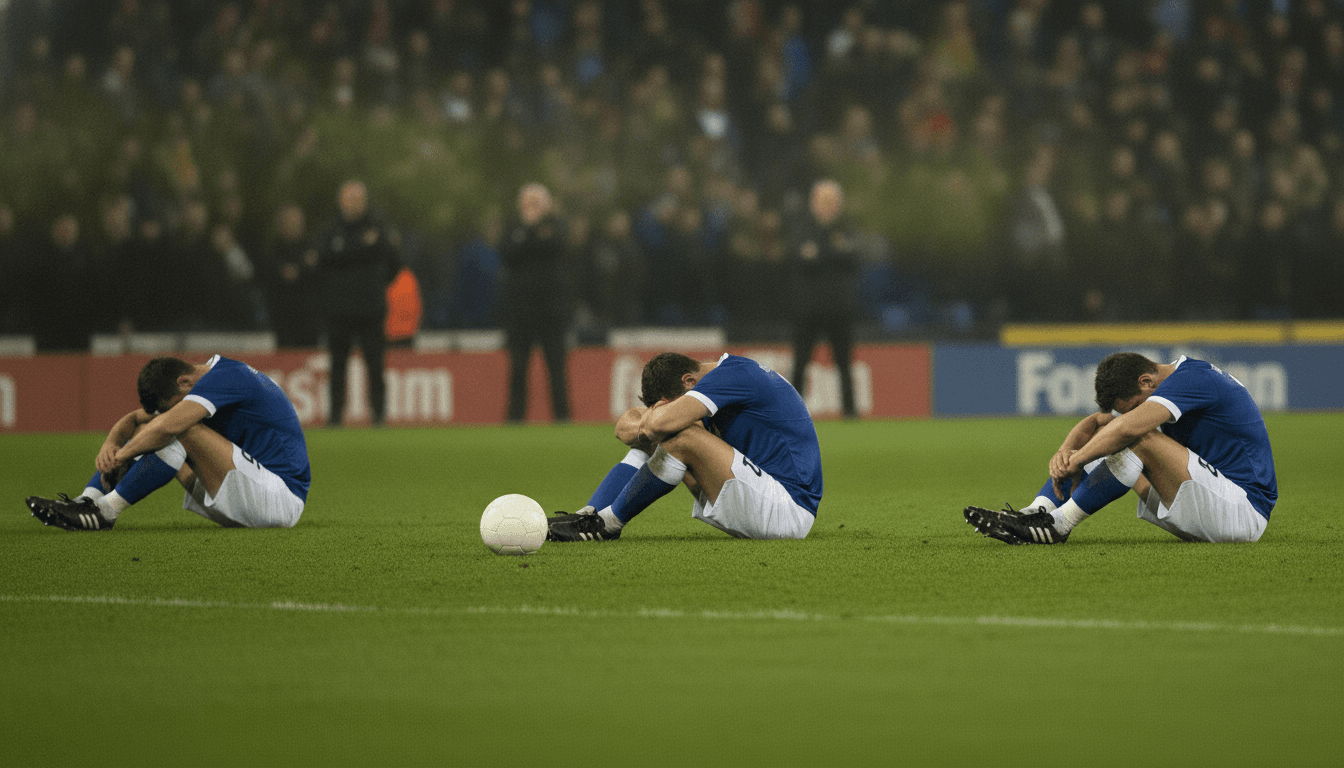
What happens when a football team gets relegated?
The final whistle on relegation day looks like any other final whistle, except the players stay down on the pitch a little longer, and the fans who haven't already left stand and clap a team that just lost its place in the top flight.
Written with AI and checked automatically before publishing. How we work
Picture a last-day defeat that confirms it: the manager stands rigid on the touchline, some players sit on the grass with their shirts over their heads, and the home end empties out slowly instead of in the usual rush. That scene, more than any table or points tally, is what relegation looks like from the stands.
What happens next is concrete and immediate. The relegated club leaves the Premier League and is dropped into the Championship, the tier below, for the following season. It is not a punishment handed out by anyone in particular, it is simply the bottom three clubs in the table swapping places with the three promoted from below.
The financial hit lands fast. Premier League television money is worth vastly more than Championship money, and a relegated club loses that income overnight. To soften the blow, these clubs usually receive parachute payments, reduced top-flight-style payouts spread over a few seasons, but even with that cushion, budgets have to shrink hard and fast.
That is why the squad gets torn apart almost immediately. The best players are sold, often to rivals still in the Premier League, because their wages no longer fit a Championship budget and their transfer fees help plug the financial gap. Lower earners are let go, loan deals are ended, and the whole wage structure is rebuilt around what Championship football can actually sustain. A squad that looked like a top-flight side in August can look unrecognisable by the following summer.
The manager rarely survives it. It is common for the head coach to be sacked either the moment relegation is confirmed or within the weeks that follow, even if results were improving by the end. Boards treat relegation as a reset button, and a change in the dugout is often the first visible move, sometimes before a single player has been sold.
What happens after that split two ways, and it is genuinely unpredictable. Some clubs use the parachute payments and a settled squad to bounce straight back up the following season. Others get stuck, the finances never quite recover, the squad rebuild goes wrong, and a club can spend several seasons stranded in the lower division, sometimes sliding further instead of climbing back.
None of this is written into any rulebook beyond the simple mechanics of the table. It is habit and financial reality: clubs react to a smaller income the same way most businesses would, by cutting costs and changing leadership, and some manage that transition far better than others.



The day's football, in your inbox at 7 AM. Nothing else.
Pick of the night's matches, what the transfer window's doing, and the one column you should read today. No ads. No tips. No operators.
One-click unsubscribe. We do not share emails.
Comments
Loading comments…