
 BUL0
BUL0 EST0
EST0 CZE0
CZE0 ENG2
ENG2 LUX0
LUX0 ISL3
ISL3 SMR0
SMR0 ALB3
ALB3 SCO0
SCO0 SUI3
SUI3 SVK2
SVK2 KAZ1
KAZ1 SVN2
SVN2 MKD0
MKD0 ESP4
ESP4 CRO1
CRO1 FIN0
FIN0 BLR0
BLR0 MDA1
MDA1 FRO1
FRO1 MEX1
MEX1 PER1
PER1 USA4
USA4 CHI2
CHI2 RUS2
RUS2 IRN0
IRN0 AUS2
AUS2 BRA4
BRA4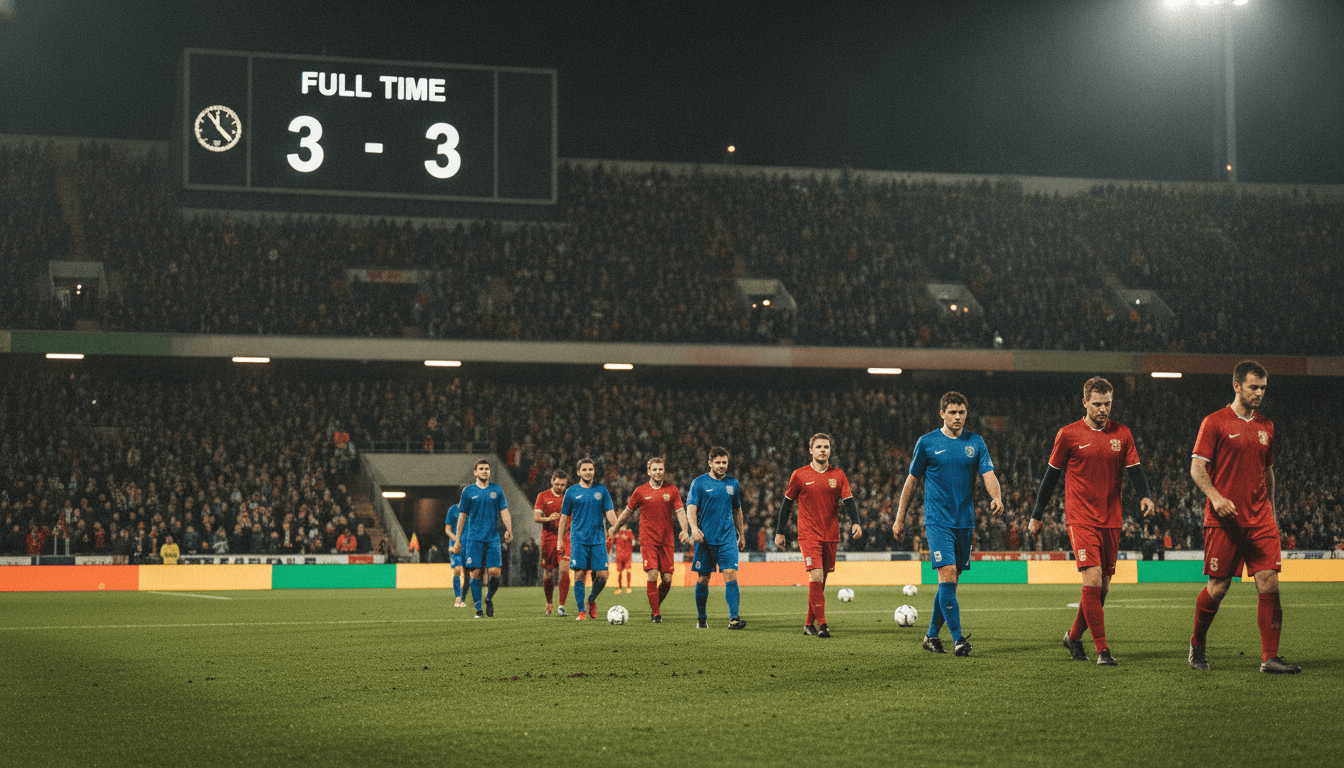
What happens when a football game ends in a draw?
The referee blows the final whistle, the scoreboard shows the same number on each side, and players simply shake hands and walk off. What happens next depends entirely on what kind of match it was.
Written with AI and checked automatically before publishing. How we work
Picture a Saturday league fixture, ninety minutes gone, score level. There's no extra period, no penalty spot marked out, no drama beyond the whistle itself. Players trudge off, coaches nod at each other, and that's it. The draw is the result. Nothing more is played.
In league football, a draw stands as a complete, valid outcome, just like a win or a loss. Each team walks away with one point added to their season total, rather than the three points a win would bring or the zero a defeat brings. Over a long season those single points add up and often decide who finishes above whom, which is why managers sometimes talk about a draw away from home as a good result, a point salvaged rather than two points dropped, depending on how the match went.
The reason league draws are left alone is straightforward: a league table is built over many games, not one. There's no need to force a winner on any single afternoon because the standings themselves will sort out who the better team was across the whole campaign. Extra time and penalties exist for a different problem entirely, a knockout competition where only one team can go through and a draw isn't an acceptable answer.
That's the picture at a cup or knockout tie. If the same scoreline happens there, teams level after ninety minutes, the game doesn't just end. Extra time is played, typically two further periods, giving both sides a chance to find a winner with fresher legs and heavier fatigue in equal measure. If nobody scores in that additional half hour, it usually comes down to a penalty shootout: players taking turns from the spot, goalkeeper against striker, until one side has more successful kicks than the other could match.
Not every competition handles a level scoreline in the same way, though. Some cup formats, rather than piling straight into extra time on the night, send the two teams away to play the whole match again on a different date, a replay. Only if that replay also finishes level does the competition then turn to extra time and penalties to force things to a conclusion. Which method gets used depends on the specific competition's own approach to breaking deadlocks, and it's worth checking before assuming a shootout is coming.
So the same scoreline, 1-1 or 0-0, can mean two completely different nights depending on the context around it. In a league game it's a quiet, ordinary result that both sets of fans can walk away from with a point in the bag. In a cup tie it might only be the halfway point of the evening, with extra time, spot kicks, or even a second match still to come before anyone actually wins anything.
The day's football, in your inbox at 7 AM. Nothing else.
Pick of the night's matches, what the transfer window's doing, and the one column you should read today. No ads. No tips. No operators.
One-click unsubscribe. We do not share emails.
Comments
Loading comments…