
 BEL0
BEL0 FRA0
FRA0 NIR0
NIR0 HUN0
HUN0 ROU2
ROU2 BIH4
BIH4 SWE3
SWE3 POL1
POL1 TUR1
TUR1 ITA4
ITA4 CHE1
CHE1 ARS0
ARS0 BIR3
BIR3 CRY3
CRY3 LIV2
LIV2 EVE0
EVE0 TOT4
TOT4 AVL0
AVL0 MAN2
MAN2 WHU1
WHU1 ARM2
ARM2 MNE3
MNE3 GEO0
GEO0 UKR0
UKR0 LVA0
LVA0 CYP0
CYP0 GER0
GER0 GRE1
GRE1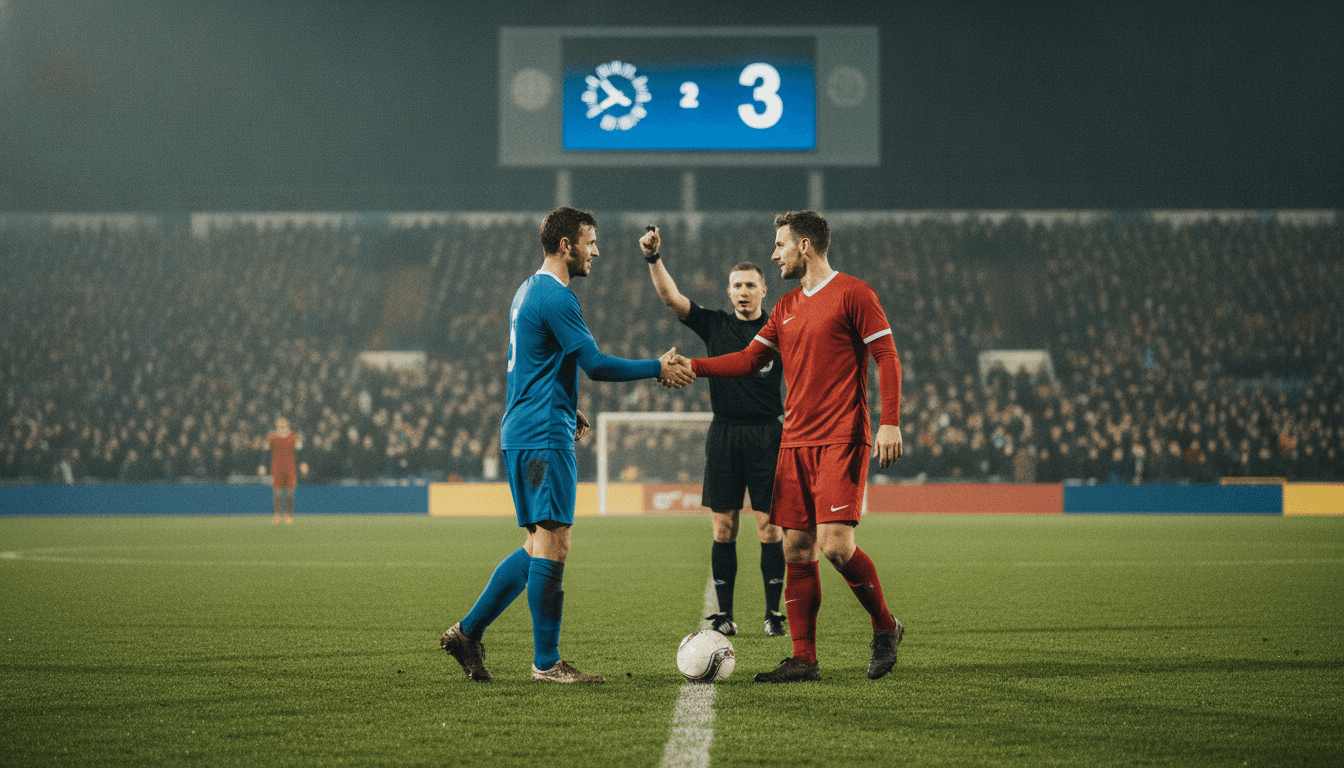
What Happens When a Football Match Is Tied?
Whether a tied football match gets settled on the spot depends entirely on what kind of competition is being played.
Written with AI and checked automatically before publishing. How we work
Picture two scenarios on the same Saturday. In one stadium, the referee blows the final whistle at 1-1 after ninety minutes, both benches shake hands, and the players walk straight down the tunnel. In another stadium, at 1-1 after ninety minutes, nobody leaves the pitch, the players get a short break, drink some water, and go back out for another thirty minutes of football, and if that still doesn't settle it, the game moves to a row of penalty kicks.
Which one happens depends on the type of match. In a league game, a tied score after ninety minutes simply ends the contest. There's no extra time, no shootout, nothing added on. The whistle goes, the scoreboard stands, and that's the result.
A tied league match still matters in the table, though. Instead of the usual three points going to a winning team, both sides collect one point each. Over a long season built from dozens of these matches, that single point from a draw can be the difference between finishing above or below a rival, so a tie is far from a non-event even though nothing extra is played on the day.
Cup and knockout football works on a different logic, because someone has to advance to the next round and a draw can't do that job. So if the score is level after ninety minutes in a cup tie, the players stay out for extra time, an additional period tacked onto the match specifically to try to produce a winner. If the sides are still tied once that extra time finishes, the match is decided by a penalty shootout: players from each team take turns shooting from the penalty spot until one side has scored more than the other could match.
That's the standard picture now, but it hasn't always been the only way cup ties got resolved. Some domestic cup competitions used to handle a tied knockout match by scheduling a replay, sending the two teams away to play the whole fixture again on another day, often at the other team's ground, rather than pushing straight into extra time and penalties. That approach has become rare, but it's the exception a reader might come across in older football or in a competition that has kept the tradition alive, and it explains why you might occasionally hear commentators talk about a tie needing to be replayed rather than settled with a shootout.
So the short version is this: how a tied match gets resolved depends on what's actually at stake. A league fixture is about accumulating points over a whole season, so a draw is simply logged and the season moves on. A cup tie is about survival, win or go home, so the format is built to force a winner on the day, first through extra time and then, if needed, through penalties. The one thing that never happens in modern football is a match just being left tied with no result recorded at all; league draws get their points, and cup ties get pushed until somebody wins.
The day's football, in your inbox at 7 AM. Nothing else.
Pick of the night's matches, what the transfer window's doing, and the one column you should read today. No ads. No tips. No operators.
One-click unsubscribe. We do not share emails.
Comments
Loading comments…