


Why are footballers wearing black armbands?
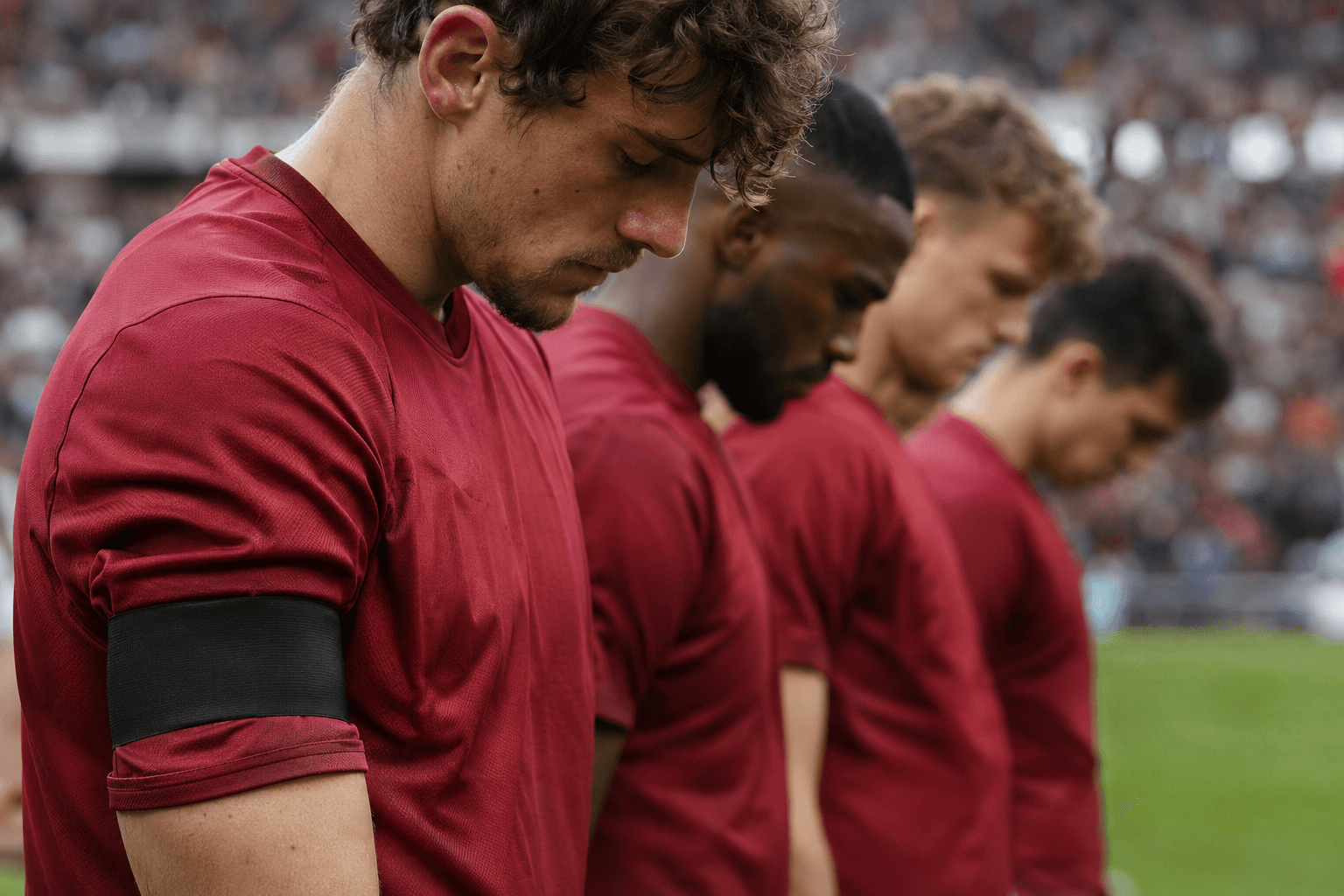
Look at a player's right sleeve before kick-off on certain days and you will see a plain strip of black cloth wrapped around the upper arm. There is no badge or slogan on it. Often the players then line up together, stand still and go quiet for a minute before the match begins.
That band means the team is in mourning. Players wear it after the death of someone who mattered to a club or to the sport, or to mark a tragedy. That can be a loss from the past week or one that happened decades ago and is remembered on its anniversary.
It is a custom rather than a fixed law of the game. Football has borrowed it from everyday life, where a black armband has long been a way of showing grief. Whether a team wears one is usually decided case by case by the club, the league or the federation, and the band goes on the kit, where the crowd in the stadium and people watching at home can see it.
The BBC points to two kinds of occasion. The first is the anniversary. Hillsborough and the Munich air crash are both remembered this way, so a black armband can appear on a date that means nothing to a casual viewer but a great deal to the clubs and fans involved. The second is a fresh loss. When Leicester City owner Vichai Srivaddhanaprabha died in a helicopter crash, Premier League players wore black armbands in their next games as a mark of respect. The armbands were not worn only by the club that had lost its owner: players across the league wore them.
The armband rarely appears alone. Teams often hold a minute's silence before kick-off on the same day, according to the Bundesliga's guide to the game. Players usually stand together, sometimes with heads bowed, while the crowd falls quiet too.
If you see the bands and do not know why, the reason is almost always one of those two things: someone has died recently, or it is the anniversary of a disaster. Clubs and leagues usually explain the reason before the game.
Black armbands are normally worn on the right arm. As the BBC explains, that keeps them from being mixed up with the captain's armband, which usually sits on the left sleeve. A captain's band marks out the one player who leads the team, and a mourning band on the same arm could blur with it from a distance.
A captain on a day of mourning wears both: the captain's band on the left arm and the black band on the right. This is the usual practice rather than a fixed one, so now and then you may see it done differently. If a player has a band on each sleeve, the one on the right is the one for grief.
Sources2 sources
We name and link every outlet this article draws on, and rewrite their reporting in our own words rather than reprinting it.
More on Other football
See more



“Another angle on the same week.”
 MORE
Do footballers get paid weekly or monthly?
A transfer story or TV graphic says a player will earn a big sum 'a week'. That wording describes how the deal is reported, not how often he gets paid. Top-flight players are generally paid once a month.
The day's football, in your inbox at 7 AM. Nothing else.
Pick of the night's matches, what the transfer window's doing, and the one column you should read today. No ads. No tips. No operators.
One-click unsubscribe. We do not share emails.
Comments
Loading comments…