
 BOL0
BOL0 PAR2
PAR2 CHE1
CHE1 ARS0
ARS0 BIR3
BIR3 CRY3
CRY3 LIV2
LIV2 EVE0
EVE0 TOT4
TOT4 AVL0
AVL0 MAN2
MAN2 WHU1
WHU1 LCL2
LCL2 BHA0
BHA0 CHA0
CHA0 MNC1
MNC1 GER0
GER0 GRE1
GRE1 ISR0
ISR0 IRL3
IRL3 NOR1
NOR1 POR2
POR2 AUT3
AUT3 KOS1
KOS1 DEN2
DEN2 WAL0
WAL0 GIB0
GIB0 AND0
AND0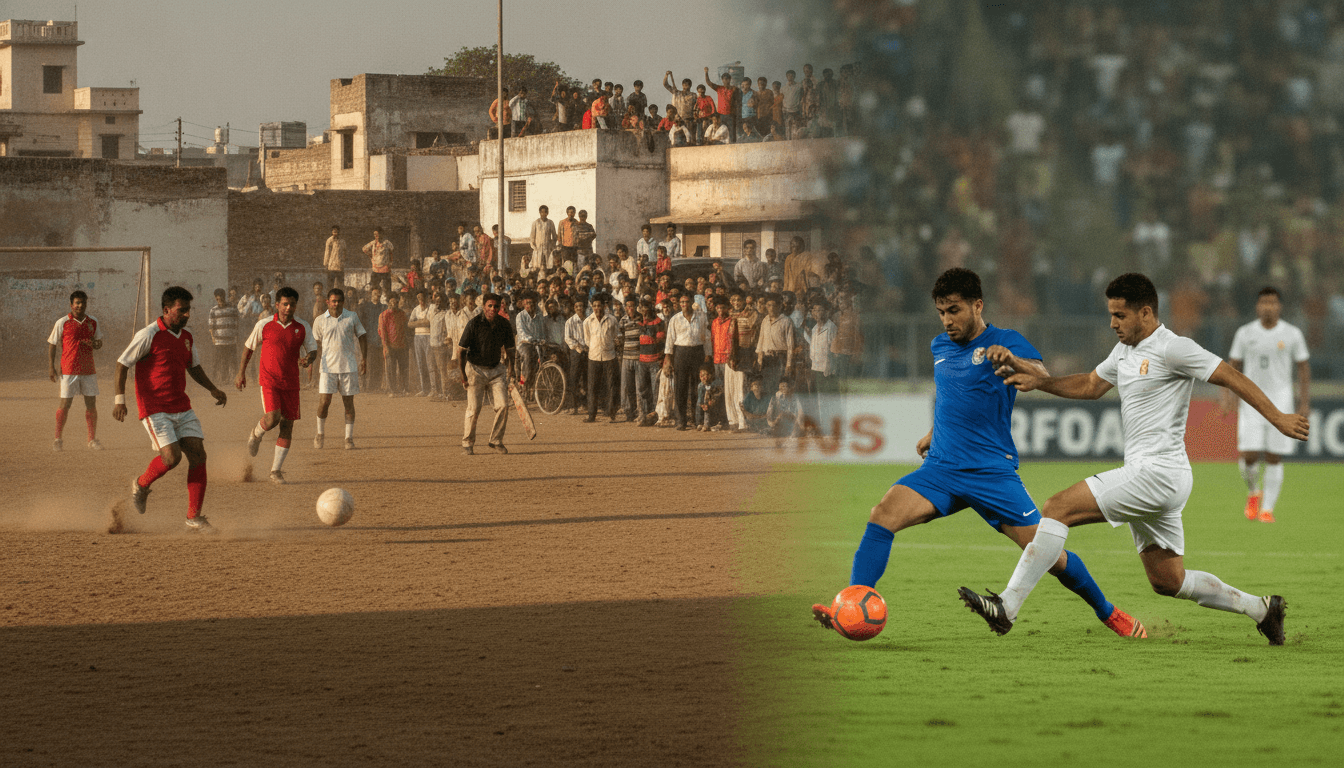
Why Isn't Football Popular in India?
Walk through most Indian cities and the street game you'll see kids playing with a bat and tennis ball, not a football. The reasons for that go back decades and run deeper than simple taste.
Written with AI and checked automatically before publishing. How we work
Picture a school playground in most parts of India during a break. A cluster of boys is bowling and batting with whatever they've got, a plastic bat, a tennis ball, a chalk-marked wicket on a wall. Football, if it's there at all, is usually a smaller circle in the corner. That split in playgrounds mirrors the split in the country's sporting attention as a whole.
The simplest answer is cricket got there first and never let go. India's win at the 1983 World Cup turned cricket into a national obsession almost overnight, and every generation since has grown up inside that obsession, watching it, playing it, measuring success by it. Football never had a comparable moment to hook the country in the same way.
That head start became self-reinforcing. Once cricket had the crowds, it got the money, and once it had the money, it got the infrastructure. Youth cricket academies, school programmes, state associations and coaching pipelines were built up over decades. Football's grassroots system, by contrast, has stayed thin, fewer trained coaches, fewer structured youth leagues, fewer clear paths from a kid kicking a ball in a lane to a professional career. A talented young footballer in most Indian towns simply has fewer places to be found and developed.
Money follows the same pattern. Television networks and sponsors put their heaviest weight behind cricket because that's where the audience already is, which then starves football of the broadcast slots and advertising that could grow its own audience. It's a loop: less coverage means less visibility, less visibility means less interest, less interest means less investment, and the cycle repeats.
International success plays into it too. Cricket has given Indian fans World Cup wins and moments to build a national identity around. The Indian football team has never qualified for a World Cup or produced a comparable breakthrough on the world stage, so there's no equivalent spark, no single result that pulled millions of new fans in overnight the way 1983 did for cricket.
The league structures reflect the imbalance as well. Cricket's domestic competitions have had generations to mature, build fan loyalty and turn players into household names. India's football league, the ISL, is still relatively young and smaller in scale, without the decades of history that let a cricket tournament become part of family routine.
None of this means football is absent from India. In Kerala, West Bengal and Goa, football isn't a niche interest, it's the dominant sport, with passionate local followings, packed stadiums for big derbies and a footballing culture that goes back generations. In those regions the sport carries the same weight cricket does elsewhere in the country. What India lacks isn't football love, but football love spread evenly enough, and backed by enough infrastructure and money, to challenge cricket on a national scale.
The gap, then, isn't really about which sport is more exciting to watch. It's about which one got the fifty-year head start in schools, on television, and in the wallets of sponsors, and cricket got there first.


The day's football, in your inbox at 7 AM. Nothing else.
Pick of the night's matches, what the transfer window's doing, and the one column you should read today. No ads. No tips. No operators.
One-click unsubscribe. We do not share emails.
Comments
Loading comments…