
 COV1
COV1 NEW0
NEW0 LEV0
LEV0 SEV1
SEV1 LIV0
LIV0 MNC3
MNC3 CRY3
CRY3 NFO1
NFO1 HUL2
HUL2 EVE2
EVE2 RAC2
RAC2 VAL2
VAL2 BET5
BET5 OSA2
OSA2 RSO3
RSO3 DEP2
DEP2 ELC0
ELC0 CEL0
CEL0 RCL
RCL SCP
SCP SAB
SAB SLP
SLP ARS
ARS LILL
LILL ATM
ATM MAN
MAN GAL
GAL BAR
BAR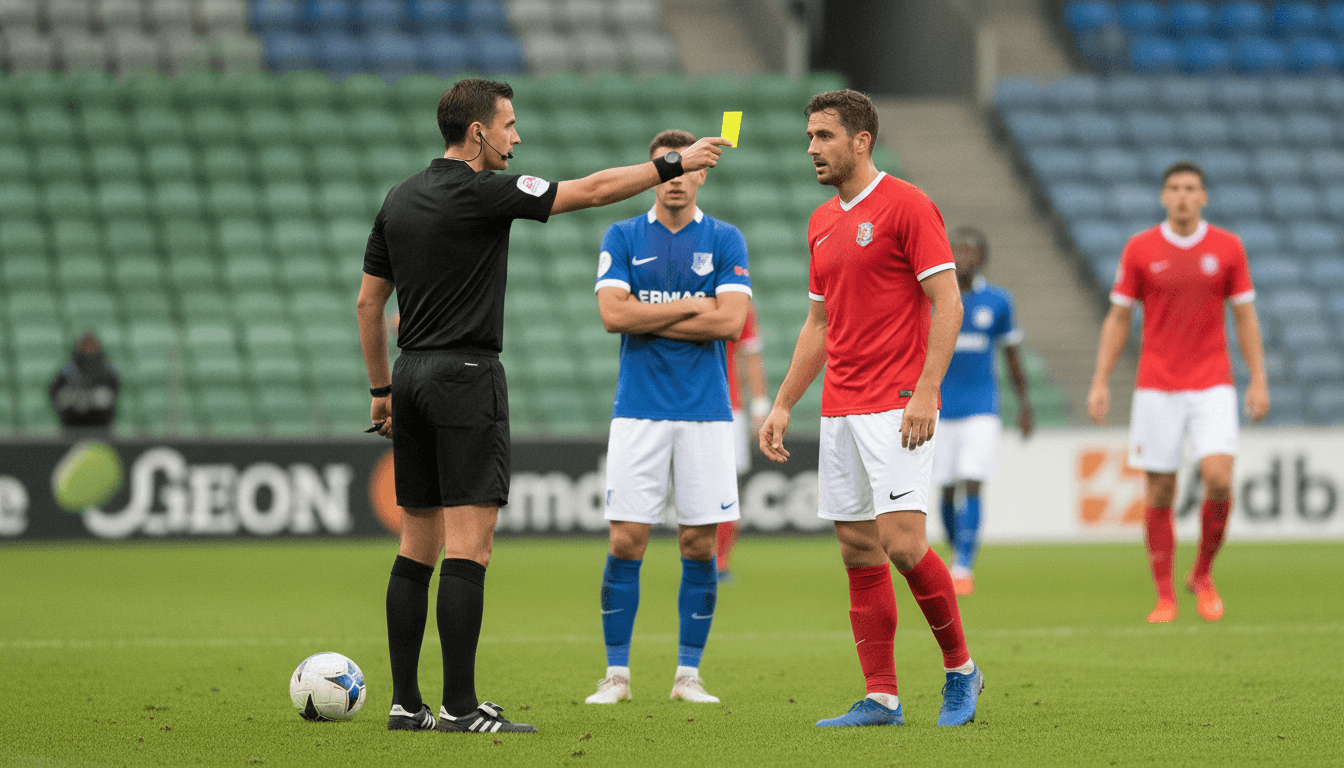
What does it mean when a footballer gets a yellow card?
A player slides in late, catches an opponent's shin, and the referee stops play, reaches into his pocket and holds up a small yellow rectangle above his head. Here's what that card actually does.
Written with AI and checked automatically before publishing. How we work
Picture it: the whistle goes, the referee jogs over, pulls a card from his pocket and raises it so everyone, players, bench, crowd, can see it. The player whose name it's for either nods, argues, or just turns and walks back to his position. That small square of card is a yellow card, and it's a caution. It's a formal warning written into the record of the match against that player's name.
A yellow card is a caution shown by a referee to a player for various offences during a match. It doesn't stop the player taking part, he carries on playing, but he now carries a mark that matters for the rest of the game and sometimes beyond it.
Referees reach for the yellow card for a specific list of things: unsporting behaviour, reckless challenges, breaking up a promising attack, dissent, and other forms of misconduct. The IFAB Laws of the Game, in Law 12 on Fouls and Misconduct, put the reckless-tackle version plainly: "The referee stops play and cautions a player who committed a reckless challenge." That word reckless is doing real work there, it's not about whether the tackle hurt someone, it's about whether the player went into the challenge without regard for the danger to his opponent.
Dissent gets its own line in the same law. Shouting at the referee, throwing your arms up, muttering as you walk away, if it's clear or it keeps happening, it's a yellow. The Laws put it as: "Clear and/or continual dissent (with words, actions or gestures) is punished with a caution (yellow card)." Notice the and/or, a single loud outburst can be enough, or a quieter running commentary across the whole half can get you there just the same.
The card itself doesn't decide severity on a sliding scale, there's no half-yellow. But the referee has discretion in judging whether an offence crosses the line into a cautionable one at all, weighing how serious it was and the situation it happened in. A clumsy late challenge in the fortieth minute of a goalless game might get talked about; the same challenge breaking up a counter-attack with the goalkeeper stranded is more likely to get the card out.
One caution by itself just sits on the record. The real teeth come from the second one. A player who receives two yellow cards in the same match is sent off with a red card and must leave the field. Law 12 spells this out directly: "The player receives a second caution (yellow card) and is sent off (red card)." So a second yellow isn't really a yellow at all in effect, it converts straight into a red, and the team plays the rest of the match a man down.
The edge case that catches people out: cards aren't only shown while the ball is live. Yellow cards can be shown during play or when the ball is out of play, depending on the nature of the offence. That's why you sometimes see a card produced well after the foul itself, at a throw-in, during a break in play, even as players are walking off at half-time for something that happened in the tunnel area or right at the whistle. The referee doesn't lose the power to caution just because the ball has gone dead; he's simply picking the moment to act on what he saw.
Sources1 source
IFAB Laws of the Game — Law 12: Fouls and Misconduct, IFAB Laws of the Game — Law 12: Fouls and Misconduct, IFAB Laws of the Game — Law 12: Fouls and Misconduct
We name and link every outlet this article draws on, and rewrite their reporting in our own words rather than reprinting it.

The day's football, in your inbox at 7 AM. Nothing else.
Pick of the night's matches, what the transfer window's doing, and the one column you should read today. No ads. No tips. No operators.
One-click unsubscribe. We do not share emails.
Comments
Loading comments…