
 IND1
IND1 PAN1
PAN1 AUS1
AUS1 BRA1
BRA1 USA
USA PER
PER CAN
CAN CHI
CHI MEX
MEX COL
COL COK
COK TAH
TAH VAN
VAN NCD
NCD FIJ
FIJ PNG
PNG CHN
CHN NZL
NZL SEY
SEY SRI
SRI MLT
MLT LIE
LIE JOR
JOR SYR
SYR BOL
BOL PAR
PAR KGZ
KGZ MDV
MDV
How many players are there in football?
How many players are there in football?
Before kickoff, the referee runs an eye down each line of players standing in the centre circle, counting heads. Here is the number they are checking for, and what happens if it falls short.

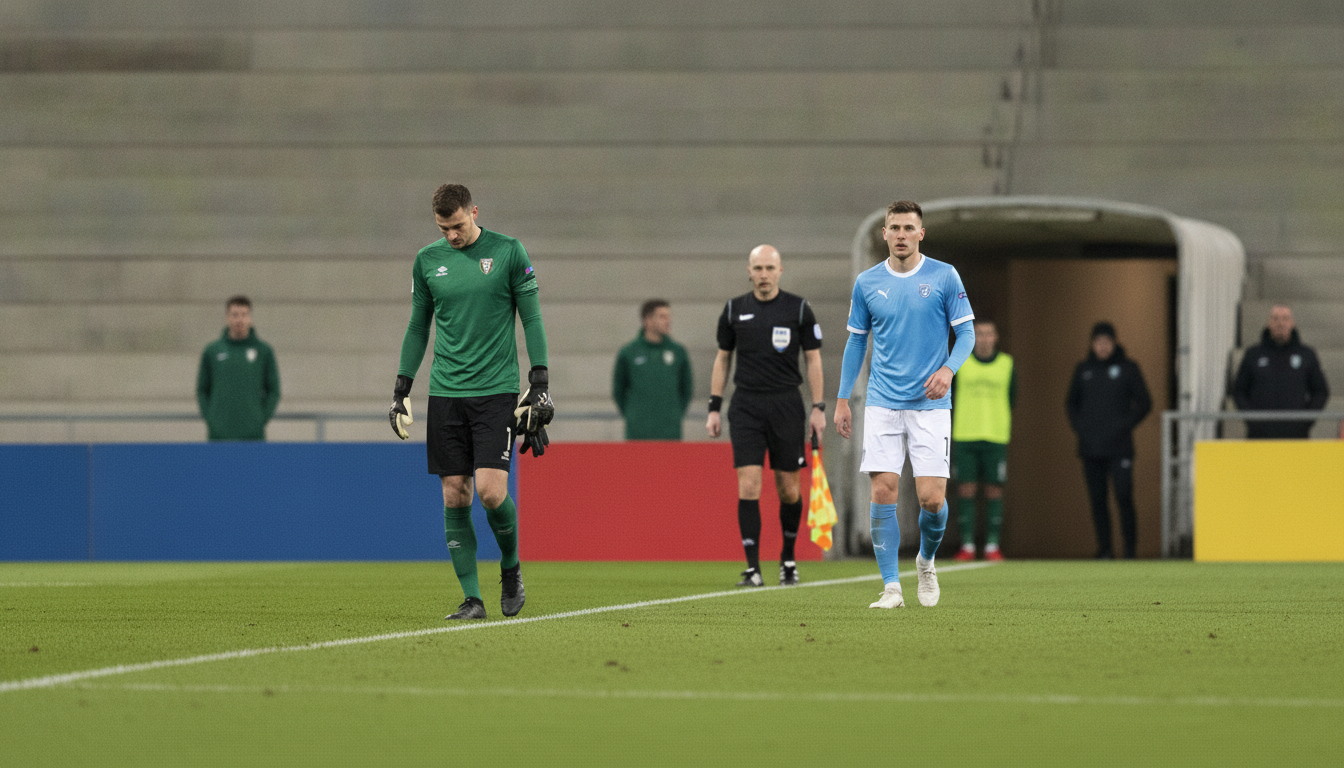
Watch the two teams walk out before a match and you can count them yourself: ten outfield players a side, plus one wearing gloves and a different shirt, standing apart from the rest near the goal. That eleventh player is the goalkeeper, and every team must have one.
The number is eleven per side, no more. Football's rulebook, the IFAB Laws of the Game, states it in a single line in Law 3: "A match is played by two teams, each with a maximum of eleven players; one must be the goalkeeper." The word doing the work there is maximum. A team can play with fewer than eleven, through injury, sending-off, or just not having enough players available, but it can never field more.
The goalkeeper requirement is not a suggestion either. A team cannot simply push everyone forward and defend with ten outfield players and no keeper. Someone has to hold that role, distinguishable by kit, allowed to use their hands inside their own penalty area.
What a reader might not expect is that the Laws also set a floor, not just a ceiling. A match cannot start, or carry on, if a team drops below seven players. The exact wording covers more ground than that single number suggests: "A match may not start or continue if either team has fewer than seven players (not including temporary dismissals or one-minute periods off the field of play in connection with the 'Time-limited substitution protocol' or the 'Off-field treatment and assessment protocol')." That parenthesis is doing real work, a player being treated for an injury off the pitch for a minute, or serving a short spell off during a time-limited substitution, does not count as missing from the seven. The rule cares about who is actually unavailable to the team, not who happens to be off the field for a moment.
So the range a match can legally be played within runs from seven up to eleven per side. Drop below seven, through a string of red cards, say, and the referee has to abandon the game. There is no rule forcing a team with, for instance, nine players to keep going to the final whistle if numbers fall further during the match; the seven-player floor applies at every point, not just at kickoff.
Substitutes sit outside all of this counting. How many a team is allowed to use during a match is left to competition rules rather than fixed in Law 3 itself, which is why the number of substitutes permitted varies between competitions and has changed over the years, while the eleven-a-side maximum and the seven-player minimum have not.
The goalkeeper rule also has less obvious consequences. If a keeper is sent off and the team has already used all its permitted substitutes, an outfield player has to pull on the gloves, teams are never allowed to play on without someone designated to fill that role. The Law does not carve out an exception for this; the requirement that one of the eleven must be the goalkeeper holds regardless of the circumstances that got a team down to its last fit body between the posts.
Sources1 source
IFAB Laws of the Game — Law 3: The Players, IFAB Laws of the Game — Law 3: The Players
Flagside's editors read every piece we publish. We work from the football press, write our own copy rather than reprinting anyone's, and check each article for accuracy and sourcing. Every outlet that fed into this piece is named under Sources.



The day's football, in your inbox at 7 AM. Nothing else.
Pick of the night's matches, what the transfer window's doing, and the one column you should read today. No ads. No tips. No operators.
One-click unsubscribe. We do not share emails.
Comments
Loading comments…