
 BEL3
BEL3 TUR0
TUR0 BIH1
BIH1 SWE1
SWE1 FRO1
FRO1 SVK1
SVK1 FRA1
FRA1 ITA1
ITA1 HUN1
HUN1 GEO0
GEO0 POL6
POL6 ROU0
ROU0 UKR0
UKR0 NIR3
NIR3 CYP2
CYP2 ARM0
ARM0 LVA1
LVA1 MNE2
MNE2 KAZ1
KAZ1 MDA2
MDA2 COL0
COL0 PAR1
PAR1 MRI3
MRI3 SRI0
SRI0 COD0
COD0 UGA2
UGA2 CHN0
CHN0 PLE5
PLE5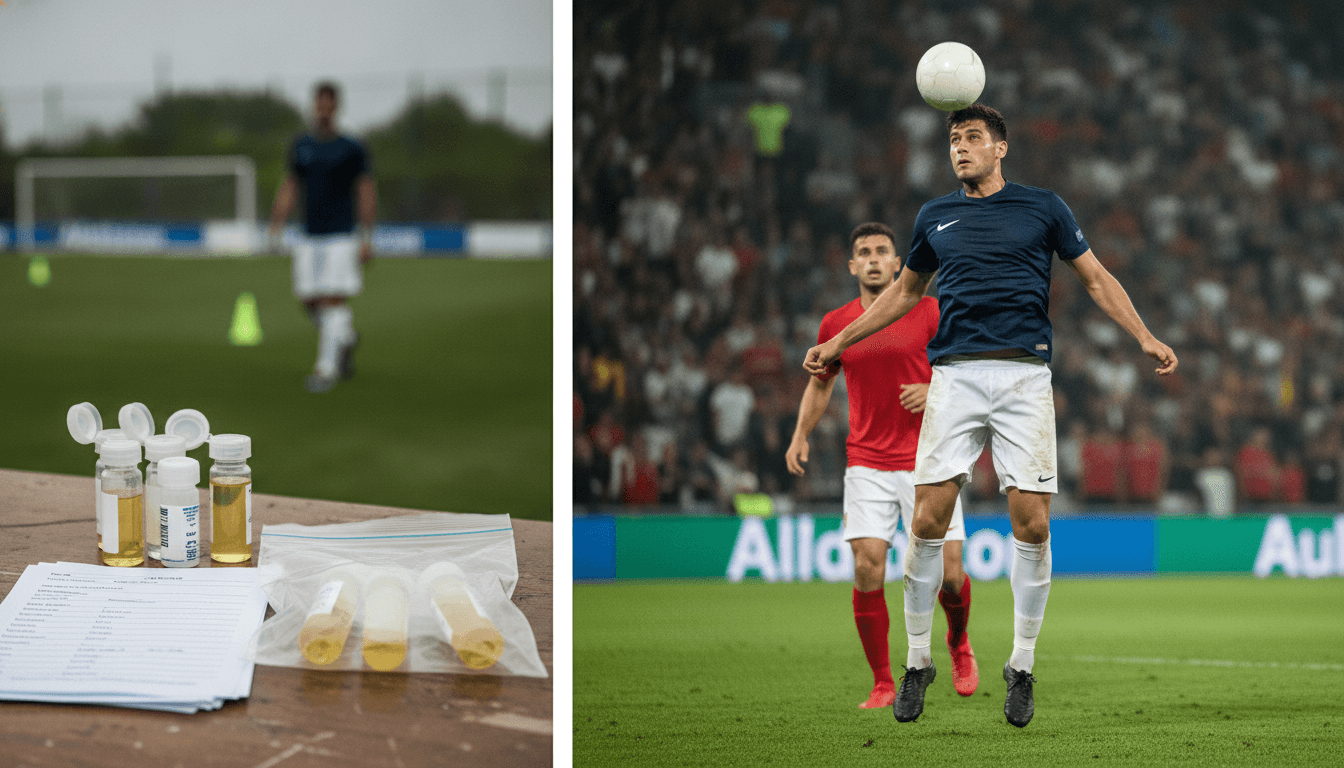
Do footballers get drug tested?
A player walks off after full time and is met by an official holding a plastic cup, not a camera. That's the start of a drugs test, and it happens far more often than most fans ever see.
Written with AI and checked automatically before publishing. How we work
Picture it: the final whistle goes, and instead of heading straight for the tunnel, one or two players are pulled aside by a doping control officer. They're walked to a side room, handed a sealed cup, and asked to produce a urine sample under supervision. No one chooses this moment for drama, it's routine, and it happens after matches on a regular basis.
Yes, professional footballers are tested regularly. It isn't a once-a-season formality. Testing happens both after games and, just as often, completely unannounced at training grounds, with no advance warning to the player. A tester can simply turn up on a Tuesday morning, find the squad doing a passing drill, and pull someone out of the session.
The samples collected are usually urine, though blood is sometimes taken too. What they're screened for is broader than most people assume: it isn't only performance-enhancing substances like steroids or stimulants, but recreational drugs as well. A player doesn't need to be chasing a competitive edge to fail a test, a positive result for a recreational drug counts just the same as one for a banned performance enhancer.
The reason testing works this way, turning up unannounced, at training as well as matches, is simple enough: if players only got tested after games, anyone wanting to cheat could simply time their use around the predictable moments. Catching someone off guard at a Tuesday training session closes that gap. There's no fixture to plan around, no warning to clear a system in time.
What a lot of fans don't realise is how this usually surfaces in public. Testing itself is quiet and constant, most results never make the news because they're clean. It's only when a result comes back positive that the story becomes visible, and at that point it moves out of a lab and into a disciplinary process. A positive test can lead to a suspension from playing, and it's that kind of case, a name, a ban, a headline, that tends to be what sends people searching to find out whether this testing happens at all.
So the testing a reader hears about in the news is really the exception, not the rule. The player stopped at random after a Wednesday training session, asked to fill a cup while a club official watches, is the far more common and far less newsworthy version of the same process. It's built to be unpredictable precisely so that there's no safe window to avoid it.



The day's football, in your inbox at 7 AM. Nothing else.
Pick of the night's matches, what the transfer window's doing, and the one column you should read today. No ads. No tips. No operators.
One-click unsubscribe. We do not share emails.
Comments
Loading comments…