


How long can a football game last? The rulebook answer
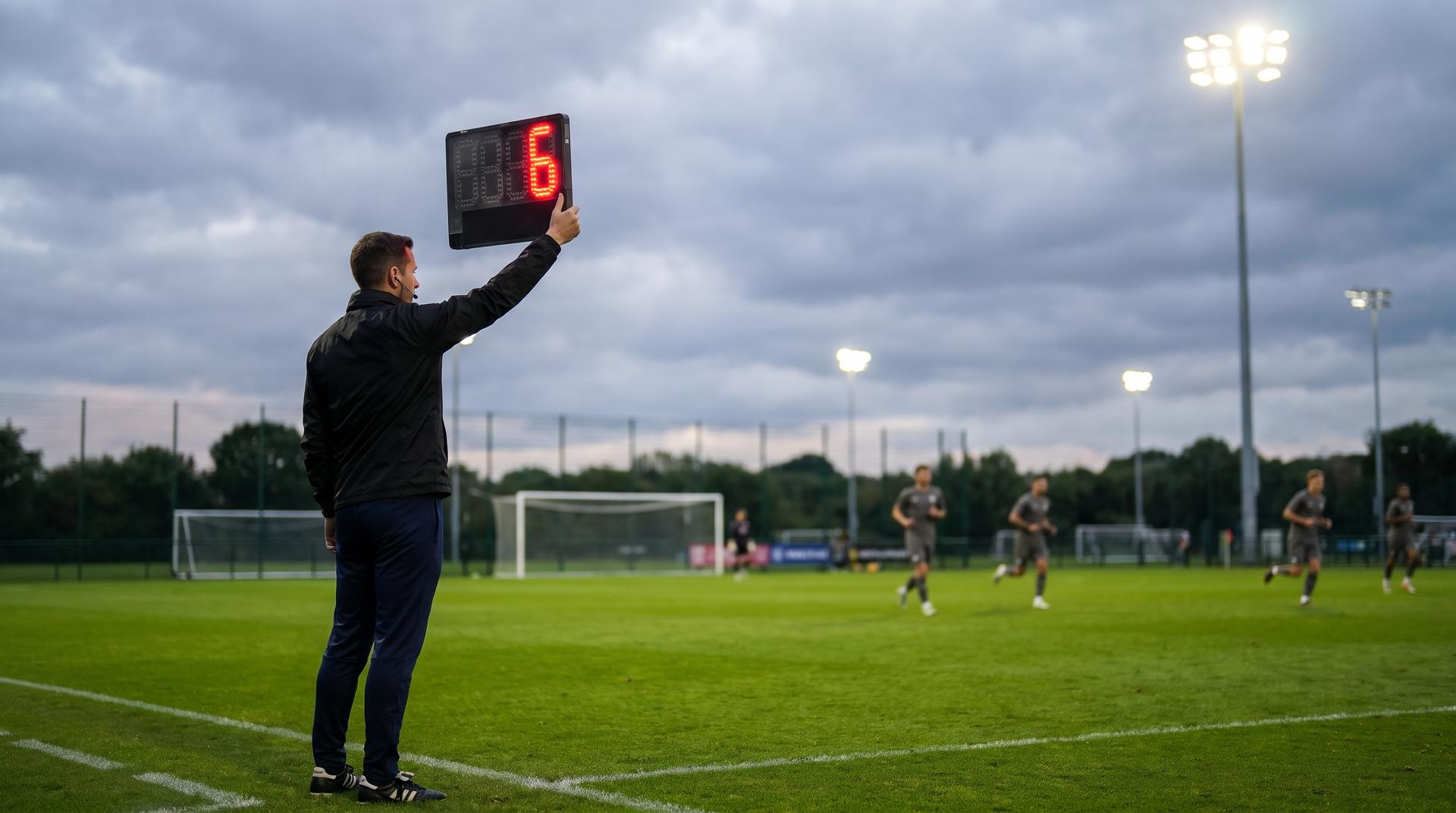
The clock reaches 45 minutes and the game does not stop. Play goes on while the added minutes are shown, and the players keep running until the referee decides the half is over.
A football match is 90 minutes of playing time, split into two halves of 45 minutes, plus whatever extra time the referee adds at the end of each half. The rulebook sets no single maximum for how long a match can last. The total depends on how much time was lost and on one special case involving penalties.
The rule is Law 7 of the IFAB Laws of the Game, "The Duration of the Match". It opens: "A match lasts for two equal halves of 45 minutes, which may only be reduced if agreed between the referee and the two teams before the start of the match." The two halves must be the same length. A match can be made shorter, but only if the referee and both teams agree, and only before kick-off. Once the game has started, nobody can decide to cut it short.
The added time is where the length changes. The referee adds time at the end of each half to make up for stoppages. The Law also tells the referee to allow for time lost in other ways, and it names goal celebrations as one of them. So a long celebration does not just use up the clock: the referee can add it back at the end of the half.
Because the added time depends on what happens in each half, nobody can say before kick-off exactly how long a match will run. The Laws give a fixed base of 90 minutes and a way of adding to it, but no upper limit.
Cup ties are different again. If the competition rules provide for it, a drawn match can go to extra time, two further periods of 15 minutes, and then to a penalty shootout. So 90 minutes is the length of a standard match, not of every match.
A late stoppage works the other way and stops added time from growing. Law 7 says: "If there is a stoppage towards the end of the game that is longer than the remaining playing time, the 'additional time' played is the remaining playing time, not the length of the stoppage."
In practice: say 3 minutes of added time are shown, then a long stoppage comes late in the game, longer than the time still left to play. The referee does not add the full length of that stoppage on top. Only the remaining playing time is made up, so a long delay at the end does not turn into a long extension.
The last question is what happens if a match cannot be finished at all. Law 7 answers this as well: "An abandoned match is replayed unless the competition rules or organisers determine otherwise." Competition rules can set a different outcome, such as letting the score stand or awarding the result, so the time already played can still matter depending on the competition.
Penalties are the one case where a half can run past its added time. Law 7 says: "If a penalty kick has to be taken or retaken, the half is extended until the penalty kick is completed." If a penalty is given as time runs out, the half does not end on the referee's watch. It ends when the kick is over, and if the kick has to be retaken, the half keeps going until the retake is done too.
Sources1 source
IFAB Laws of the Game — Law 7: The Duration of the Match, IFAB Laws of the Game — Law 7: The Duration of the Match, IFAB Laws of the Game — Law 7: The Duration of the Match, IFAB Laws of the Game — Law 7: The Duration of the Match
We name and link every outlet this article draws on, and rewrite their reporting in our own words rather than reprinting it.
More on Other football
See more


“Another angle on the same week.”
 MORE
How long can a football contract be? FIFA's five-year maximum
Clubs love to announce long deals, but FIFA's rulebook sets a standard maximum. A professional contract can run for five years, or three if the player is under 18, and it can be as short as the rest of a single season.
Sign up for the Flagside newsletter.
We use your address only for the Flagside newsletter.
We do not share email addresses.
Comments
Loading comments…