


Is it allowed to push in football? What the rulebook says
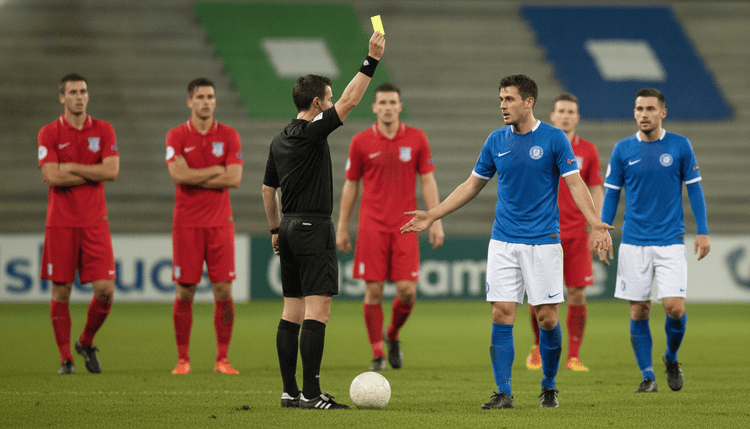
Photo: Stephen Craven / Wikimedia Commons (CC BY-SA 2.0) · Source
An attacker drops back to wait for a high ball. The defender behind him plants two hands in his back and shoves. The attacker stumbles forward, the ball sails over both of them, and the referee blows the whistle.
That whistle is the answer. Pushing an opponent is not allowed. It is one of the offences listed in Law 12 of the IFAB Laws of the Game, and it gives the other team a direct free kick. Most fans know that much. Fewer have read the wording.
Law 12, Fouls and Misconduct, opens the list of these offences with this sentence: "A direct free kick is awarded if a player commits any of the following offences against an opponent in a manner considered by the referee to be careless, reckless or using excessive force:"
The first phrase to notice is "considered by the referee". The rule sets no measure for how hard a push has to be. It leaves the call to the person with the whistle. The second is the three-step ladder: careless, reckless, excessive force. Every push gets placed on one of those steps, and each step comes with a different punishment.
The bottom step is careless. The Law defines it like this: "Careless is when a player shows a lack of attention or consideration when making a challenge or acts without precaution." Picture a defender who leans into a forward's back while both are watching the ball, without really thinking about it. The referee gives a direct free kick, and that is all. A careless push does not bring a card.
The middle step is reckless: "Reckless is when a player acts with disregard to the danger to, or consequences for, an opponent and must be cautioned". Look at the last three words. The player "must be cautioned". Once the referee decides a push was reckless, the yellow card is not optional. The judgement is the referee's, but the result of that judgement is fixed in writing.
The top step is excessive force: "Using excessive force is when a player exceeds the necessary use of force and/or endangers the safety of an opponent and must be sent off". A shove hard enough to put an opponent's safety at risk earns a red card. Again the rulebook says "must". There is no softer option written in.
The wording "exceeds the necessary use of force" accepts that some force is part of football. Players lean, brace and hold their ground against each other all match. The Law draws its line at force beyond what is needed, or force that endangers someone.
That is why two pushes that look much the same on television can end so differently. One push brings only a free kick, another a yellow, another a red. The rule was not applied unevenly. The referee placed each push on a different step of the ladder, and the Law then decided the punishment, whether that is a free kick, a yellow card or a red.
Sources1 source
IFAB Laws of the Game — Law 12: Fouls and Misconduct, IFAB Laws of the Game — Law 12: Fouls and Misconduct, IFAB Laws of the Game — Law 12: Fouls and Misconduct, IFAB Laws of the Game — Law 12: Fouls and Misconduct
We name and link every outlet this article draws on, and rewrite their reporting in our own words rather than reprinting it.
More on Other football
See more


“Another angle on the same week.”
 MORE
Why do referees check players' shorts?
Referees look over every player's kit before kick-off, and over every substitute before he comes on. It is a general equipment inspection required by the Laws of the Game, and shorts are one of the items on the list.
The day's football, in your inbox at 7 AM. Nothing else.
Pick of the night's matches, what the transfer window's doing, and the one column you should read today. No ads. No tips. No operators.
One-click unsubscribe. We do not share emails.
Comments
Loading comments…