
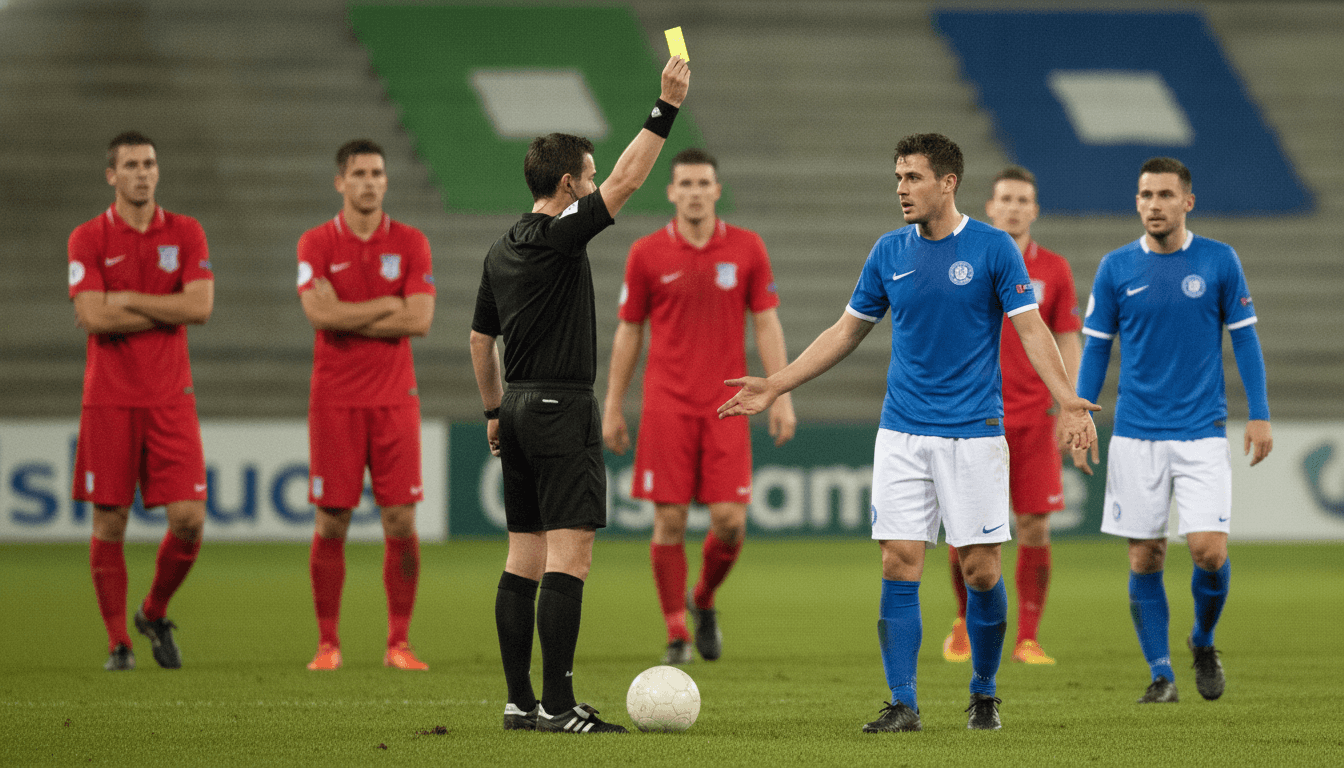
What happens when a footballer gets a yellow card?
A referee jogs over, reaches into a top pocket and holds up a small yellow rectangle above a player's head. The player grimaces, maybe says something, then jogs back into position. Nothing else happens, for now.
Written with AI and checked automatically before publishing. How we work
The moment itself is small. A defender hauls down an attacker breaking clear, or a midfielder shoves the ball away after a whistle, or someone rips their shirt off celebrating a goal. The referee stops play, walks toward the player, and raises a yellow card into the air. The player's name might go into a notebook. Then the game restarts and the cautioned player carries on as normal, same position, same ninety minutes, no immediate penalty beyond the card itself.
That is the whole answer: a yellow card is a formal warning. It does not remove the player from the pitch, does not cost their team a man, and does not stop them taking corners, tackling, or scoring five minutes later. It is a mark on the record, nothing more, unless it happens twice.
The Laws of the Game, written and maintained by IFAB, set out exactly which behaviour earns that warning. Persistent fouling, time-wasting, dissent toward the referee, and standing too close at a free kick all qualify. So does handball used to break up an attack rather than genuinely score, the Laws say a player is cautioned "if they handle the ball: to interfere with or stop a promising attack". Simulation, diving to win a free kick that was never a foul, falls under a broader heading: Law 12 states plainly that "the player is cautioned (yellow card) for unsporting behaviour." That phrase, unsporting behaviour, is doing a lot of work, it covers everything from a cynical trip to taunting an opponent, and it is left to the referee's judgement on the day rather than a fixed list.
The discretion matters because two fouls that look identical can get different treatment. A late challenge in the first minute might draw nothing but a word of warning; the same challenge in the eighty-ninth minute, against a player already through on goal, is far more likely to bring the card out. The referee is weighing not just what happened but what it stopped, a promising attack broken up unfairly is treated more seriously than a foul in a harmless area of the pitch.
The exception every fan eventually learns about is the second yellow. One caution changes nothing structurally, but a player who is cautioned twice in the same match does not get a second slip on the wrist. The Laws are direct about it: "Since the Team A player has already been cautioned, they are shown a second yellow card, followed by a red card, and sent off." Two separate yellow-card offences, shown one after the other in the same game, combine into an automatic dismissal, the team drops to ten men, and the suspension consequences that follow a red card apply just as they would for a straight sending-off.
There is no washing away a first yellow during the ninety minutes. It stays attached to the player for the rest of that match no matter how long ago it was shown, which is why a cautioned player in the first half will often visibly back off from a strong challenge, not because the rule changes, but because they know exactly how close they are to a two-card sending-off.
Sources1 source
IFAB Laws of the Game — Law 12: Fouls and Misconduct, IFAB Laws of the Game — Law 12: Fouls and Misconduct, IFAB Laws of the Game — Law 12: Fouls and Misconduct
We name and link every outlet this article draws on, and rewrite their reporting in our own words rather than reprinting it.




The day's football, in your inbox at 7 AM. Nothing else.
Pick of the night's matches, what the transfer window's doing, and the one column you should read today. No ads. No tips. No operators.
One-click unsubscribe. We do not share emails.
Comments
Loading comments…