
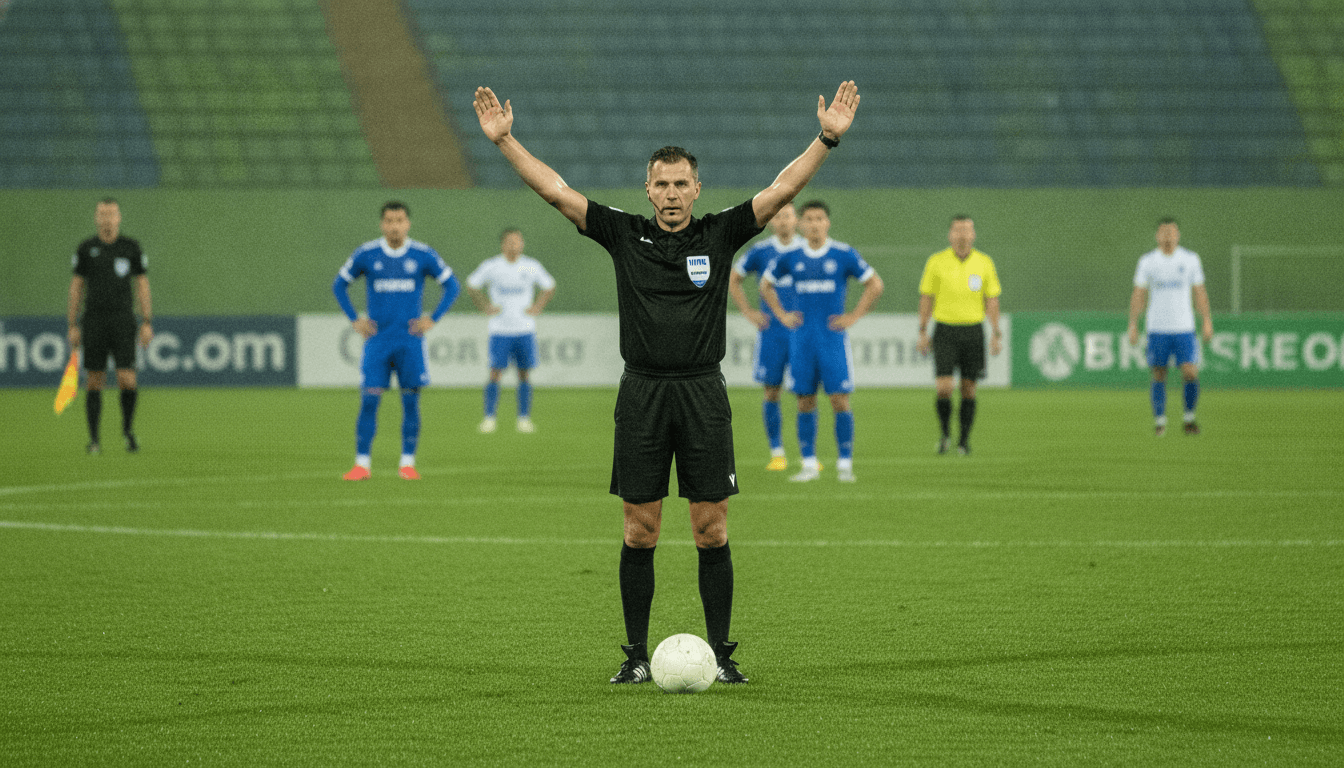
What happens if a football match is interrupted?
A floodlight fails, a storm rolls in, or fans spill onto the pitch, the referee stops the game, players jog to the sidelines, and nobody is sure yet whether this counts as a pause or the end of the match.
Written with AI and checked automatically before publishing. How we work
Picture the scene: play has stopped, the referee is talking into a radio or huddled with officials, and the two benches stand apart waiting for a signal. That moment, not the final whistle, not a goal, is where the rulebook actually gets interesting.
The referee alone decides whether to stop the match briefly, suspend it for longer, or abandon it outright. Law 7 of the IFAB Laws of the Game spells out the grounds plainly: "The referee may also decide to stop, suspend or abandon the match if the condition of the field, its surrounds or the weather conditions do not allow the game to be continued." No committee vote, no appeal on the pitch, it is the referee's call, made in real time, based on what they can see and judge about the field, the surroundings, or the weather.
If the match is abandoned rather than just paused, what happens next is not automatic. Law 7 says: "An abandoned match is replayed unless the competition rules or organisers determine otherwise." That phrase is doing a lot of work, the Law itself does not order a replay, it just sets replay as the default and then immediately hands the real decision to whoever organises the competition. A domestic cup might order a full restart from kick-off; a league might choose to let the result stand as it was, or void it entirely. The Law gives no number of minutes, no scoreline threshold, it leaves that entirely to the competition's own rules.
There is one case where the Law does commit to an outcome rather than leaving it to the organisers. If a team cannot field enough players to continue, the same article states: "In principle, where a team is responsible for a match being abandoned because it has fewer than seven players, the match will be forfeited by that team." Seven is the number that matters, not six, not five. A team that drops below that floor, through injuries or red cards, loses the match there and then rather than waiting for a replay to be scheduled. The qualifier "in principle" is the Law's own hedge, leaving room for competitions to apply it differently, but the baseline is explicit and numerical in a way the general abandonment rule is not.
Short stoppages are a separate, smaller question, and they trip people up almost as often. If play is held up near the end of a half, an injury, a pitch invasion, a VAR check, the referee does not simply add back the length of the delay. Law 7 says: "If there is a stoppage towards the end of the game that is longer than the remaining playing time, the 'additional time' played is the remaining playing time, not the length of the stoppage." In other words, if there are two minutes left on the clock and the stoppage runs for ten, the referee does not tack ten minutes onto the end, they add back two, the amount of game that was actually lost from what remained. The clock effectively pauses and resumes rather than banking the full delay.
The referee's authority stretches a little further still: they can extend a half specifically to allow a penalty kick to be completed, overriding the normal end-of-half cutoff so that a kick awarded in time does not simply vanish with the whistle.
None of this is decided by broadcasters, captains or crowd noise. It sits with one person on the pitch, applying a Law that is far more exact about player numbers and lost minutes than most fans ever expect.
Sources1 source
IFAB Laws of the Game — Law 7: The Duration of the Match, IFAB Laws of the Game — Law 7: The Duration of the Match, IFAB Laws of the Game — Law 7: The Duration of the Match
We name and link every outlet this article draws on, and rewrite their reporting in our own words rather than reprinting it.



The day's football, in your inbox at 7 AM. Nothing else.
Pick of the night's matches, what the transfer window's doing, and the one column you should read today. No ads. No tips. No operators.
One-click unsubscribe. We do not share emails.
Comments
Loading comments…