

How Many Players Are on a Soccer Team?
Eleven shirts a side, one of them gloved, but the real limit that decides whether a match can even continue sits lower down, at seven.
Written with AI and checked automatically before publishing. How we work
Picture the kickoff whistle. Two lines of players face off across the centre circle, and if you count down each row you get to eleven on one side, eleven on the other. One of those eleven, on each team, is stood apart in different-coloured kit, planted between the posts. That is the picture the rule is describing.
The maximum is eleven players per team, and one of them has to be the goalkeeper. That is the whole shape of a soccer side laid out in the Laws of the Game: "A match is played by two teams, each with a maximum of eleven players; one must be the goalkeeper." That is IFAB's Law 3, on Players, and it is worth noticing what the wording does and doesn't do, it sets a ceiling of eleven, not a fixed requirement to always have eleven, and it insists on a goalkeeper rather than leaving that as a tactical choice.
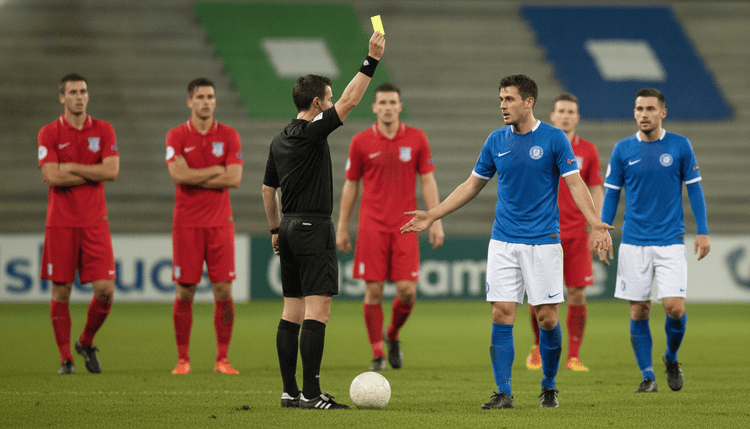
That second point matters more than it looks. A team can play with ten, nine, eight players if injuries, red cards or anything else have stripped numbers down over the course of a match. What a team cannot do is play without a goalkeeper, or with twelve players, or line up at kickoff with more than eleven. The eleven is a cap; the goalkeeper is a mandate.
The edge case is the one most fans have actually seen without knowing the number behind it: a team can shrink game by game, sending off players or losing them to injury with no more substitutes left, and the match carries on with ten, nine, eight men. But there is a floor. Law 3 sets it at seven: "A match may not start or continue if either team has fewer than seven players (not including temporary dismissals or one-minute periods off the field of play in connection with the 'Time-limited substitution protocol' or the 'Off-field treatment and assessment protocol')." Drop below seven fit players on the pitch and the game stops, whatever the scoreline.
That parenthetical is doing real work. A player being treated off the pitch for a minute, or temporarily sent off under the newer time-limited protocols, doesn't count against that seven, the rule is built around who is genuinely and permanently missing from the side, not who has stepped away for sixty seconds. It's a precise bit of drafting for what sounds like a simple headcount.
Substitutes sit outside this eleven-a-side figure entirely. The Laws don't fix one global number for how many substitutes a team can use, that is left to each competition to decide, which is why a friendly, a domestic cup tie and a major tournament can all allow different numbers of changes from the bench. What stays constant across all of them is the number out on the pitch at any one time: eleven as the cap, one of them always the keeper, seven as the point at which the match simply cannot go on.
So the answer to the simple question is simple, eleven. But the Law doesn't stop there, and the seven-player floor is the detail that actually decides matches that have been reduced by cards or injuries, long after the kickoff lineup has been forgotten.
Sources1 source
IFAB Laws of the Game — Law 3: The Players, IFAB Laws of the Game — Law 3: The Players
We name and link every outlet this article draws on, and rewrite their reporting in our own words rather than reprinting it.



The day's football, in your inbox at 7 AM. Nothing else.
Pick of the night's matches, what the transfer window's doing, and the one column you should read today. No ads. No tips. No operators.
One-click unsubscribe. We do not share emails.
Comments
Loading comments…