
 TOT0
TOT0 EVE0
EVE0 BOU2
BOU2 BRE2
BRE2 AVL1
AVL1 NFO2
NFO2 CHE2
CHE2 HUL2
HUL2 CRY2
CRY2 IPS3
IPS3 LIV0
LIV0 FUL0
FUL0 BLK3
BLK3 MIL1
MIL1 CHA0
CHA0 POR0
POR0 MID4
MID4 NOR3
NOR3 PNE0
PNE0 LCN1
LCN1 SOU4
SOU4 BRC1
BRC1 SWA3
SWA3 BUR1
BUR1 WAT1
WAT1 STK2
STK2 BOL1
BOL1 CAR0
CAR0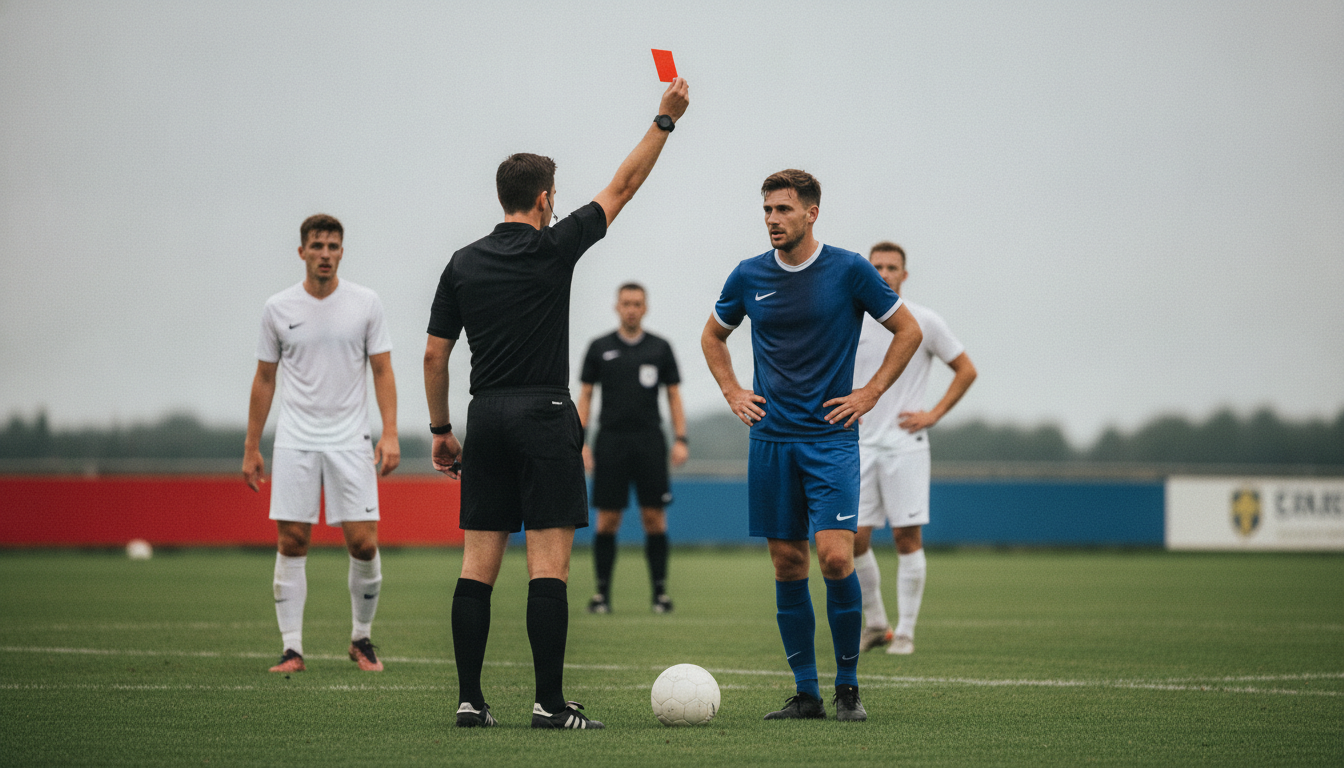
What does it mean when a footballer gets a red card?
What does it mean when a footballer gets a red card?
A referee reaches into a top pocket, holds up a red rectangle of card, and points a player toward the tunnel. Here is what actually happens next, and why the rule is written the way it is.

Picture the moment: a tackle comes in late, or a hand shoots up to stop a certain goal, and the referee's whistle goes. Players crowd round, arms out, but the official has already made the decision. Out comes the card, red instead of yellow, and the offending player turns and walks off the pitch alone. Nobody comes on to take their place.
That is the whole meaning of a red card: the player is sent off for the rest of the match, and their team is not allowed to bring on a substitute for them. From that point until the final whistle, that side plays with one fewer outfield player than the opposition. It is the harshest in-game punishment football has, and it changes the match instantly.
The Laws of the Game set out exactly what earns one. IFAB's Law 12, which covers fouls and misconduct, gives referees worked examples rather than vague guidance. One of them reads: "The referee stops play, awards a direct free kick to Team B, and sends off the defender. The red card is for 'violent conduct'". Violent conduct covers actions like striking or elbowing an opponent, whether or not the ball is anywhere near the incident. Serious foul play, a reckless, high-force tackle that endangers an opponent, carries the same punishment, worded almost identically in the Laws: "The player is sent off (red card) for violent conduct."
A red card can also arrive without a single dangerous tackle in sight. If a defender stops a certain goal by handling the ball on the line, the Law is specific about the consequence. It states: "A defending team player deliberately handles the ball within their own penalty area to prevent a goal being scored. After that, the ball does not enter the goal. What is the correct decision? The referee awards a penalty kick. The defending team player is sent off (red card)." So the team is punished twice over, a penalty for the opponent, and a player lost for the match.
There is a second route to the same outcome that has nothing to do with a single dramatic offence. A player can pick up two separate yellow cards in one match, for two lesser bookable offences, and the second one automatically becomes a sending-off. The Law states this plainly too: "The player receives a second caution (yellow card) and is sent off (red card)." This is the version fans sometimes call a "second yellow," and it is functionally identical to a straight red, the player leaves, no substitute comes on, the team plays short-handed.
The one thing a red card does not decide by itself is whether the referee's original call, penalty, free kick, goal disallowed, stands. The card is layered on top of whatever the match award already was. A team can concede a penalty and lose a player in the very same passage of play, as the handball example shows, which is why a single mistake near your own goal can do more damage in football than in almost any other sport.
Sources1 source
IFAB Laws of the Game — Law 12: Fouls and Misconduct, IFAB Laws of the Game — Law 12: Fouls and Misconduct, IFAB Laws of the Game — Law 12: Fouls and Misconduct, IFAB Laws of the Game — Law 12: Fouls and Misconduct
Flagside's editors read every piece we publish. We work from the football press, write our own copy rather than reprinting anyone's, and check each article for accuracy and sourcing. Every outlet that fed into this piece is named under Sources.


The day's football, in your inbox at 7 AM. Nothing else.
Pick of the night's matches, what the transfer window's doing, and the one column you should read today. No ads. No tips. No operators.
One-click unsubscribe. We do not share emails.
Comments
Loading comments…