
 BRE3
BRE3 TOT0
TOT0 EVE2
EVE2 CRY0
CRY0 IPS2
IPS2 SUN1
SUN1 NFO0
NFO0 LEE1
LEE1 HUL2
HUL2 MAN0
MAN0 ARS3
ARS3 COV0
COV0 BLK2
BLK2 MID1
MID1 DER2
DER2 CAR2
CAR2 PNE1
PNE1 WOL3
WOL3 QPR0
QPR0 BOL0
BOL0 SOU3
SOU3 STK1
STK1 SWA0
SWA0 SHU0
SHU0 WHU1
WHU1 CHA2
CHA2 WXM1
WXM1 WAT1
WAT1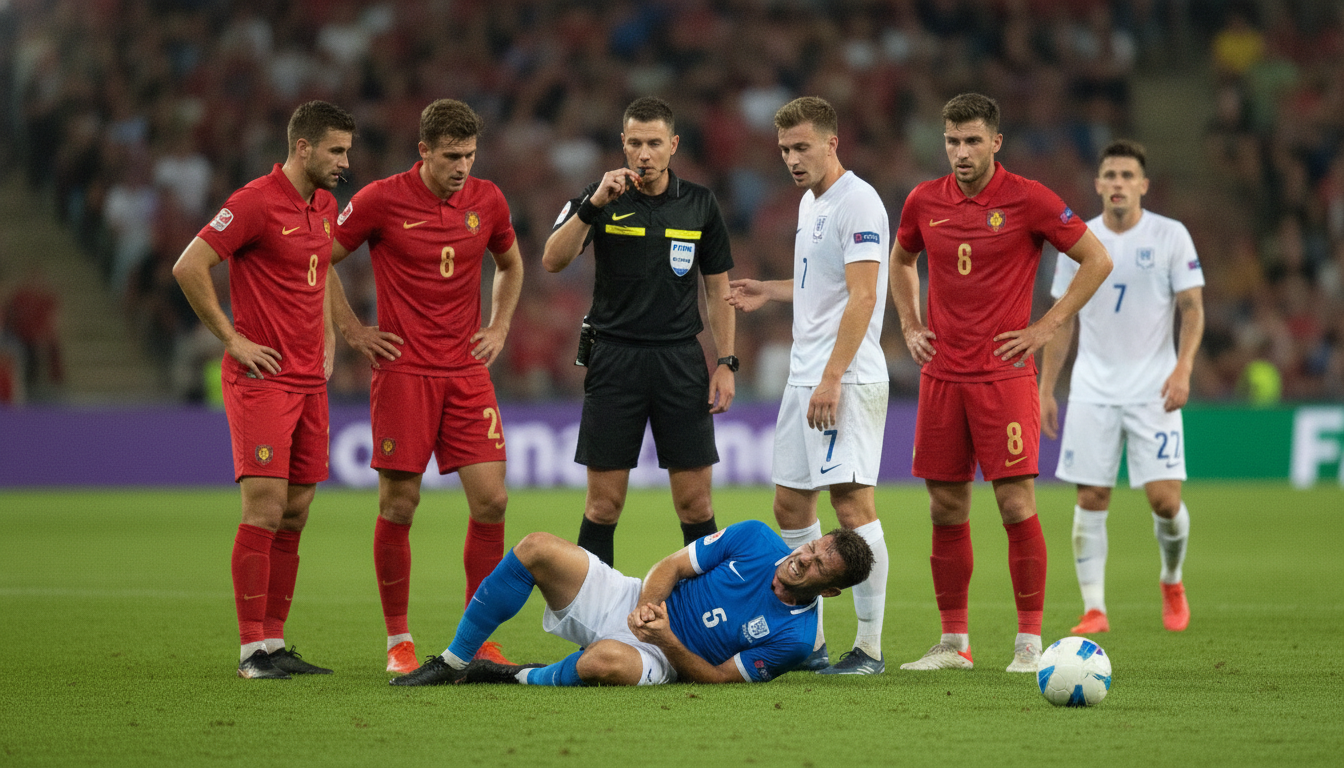
Why do football players fake injuries?
Why do football players fake injuries?
A player goes down, clutches his ankle, and the referee blows his whistle. Thirty seconds later the same player is sprinting. Here is what is actually going on.

A forward receives a nudge in the shoulder inside the penalty area. He throws his arms out, drops to the turf, and rolls twice before lying still. The referee points to the spot. The crowd erupts, half in celebration, half in fury. That is the moment most people mean when they talk about faking injuries in football, and it happens at every level of the game.
Players do it for three distinct reasons, and understanding each one makes the behaviour easier to read in real time.
The most common reason is to win a free kick or penalty in a useful position. A foul has to be committed for the referee to award either, so a player who goes down convincingly can manufacture one from contact that would otherwise mean nothing. A free kick twenty metres from goal or a penalty is worth far more to a team than staying on your feet and losing the ball, and players weigh that up in a fraction of a second.
The second reason is to get an opponent booked or sent off. If a defender is already on a yellow card, a forward who can convince the referee that a second foul was serious enough to warrant another booking has effectively removed that player from the match. A red card changes the game entirely. The incentive to go down, and to make it look bad, is enormous when the stakes are that high.
The third reason is time-wasting. A team leading by a single goal in the final ten minutes has every reason to slow the game down. A player who goes down, receives treatment, and walks slowly back into position has eaten up a minute or more of the clock. Referees can add time on, but teams have long understood that added time is rarely as long as the delay that caused it.
The line is not always clear. Most incidents are not a player inventing an injury from nothing. They are a player taking real but minor contact, a brush on the shin, a hand in the back, and exaggerating the effect to make it look like something the referee cannot ignore. The contact was genuine; the reaction was not. That grey area is where most of the argument about simulation actually lives, and it is why two people watching the same clip can reach completely opposite conclusions.
The edge most viewers miss is that the same player can be doing two of these things at once. Going down in the box late in a match when your team is winning serves both the penalty threat and the clock. A player who draws a red card from a tackle he barely felt has achieved something his manager would struggle to criticise openly, whatever the public reaction.
The day's football, in your inbox at 7 AM. Nothing else.
Pick of the night's matches, what the transfer window's doing, and the one column you should read today. No ads. No tips. No operators.
One-click unsubscribe. We do not share emails.
Comments
Loading comments…