
 BRE3
BRE3 TOT0
TOT0 EVE2
EVE2 CRY0
CRY0 IPS2
IPS2 SUN1
SUN1 NFO0
NFO0 LEE1
LEE1 HUL2
HUL2 MAN0
MAN0 BLK2
BLK2 MID1
MID1 DER2
DER2 CAR2
CAR2 PNE1
PNE1 WOL3
WOL3 QPR0
QPR0 BOL0
BOL0 SOU3
SOU3 STK1
STK1 SWA0
SWA0 SHU0
SHU0 WHU1
WHU1 CHA2
CHA2 WXM1
WXM1 WAT1
WAT1 BIR2
BIR2 BRC2
BRC2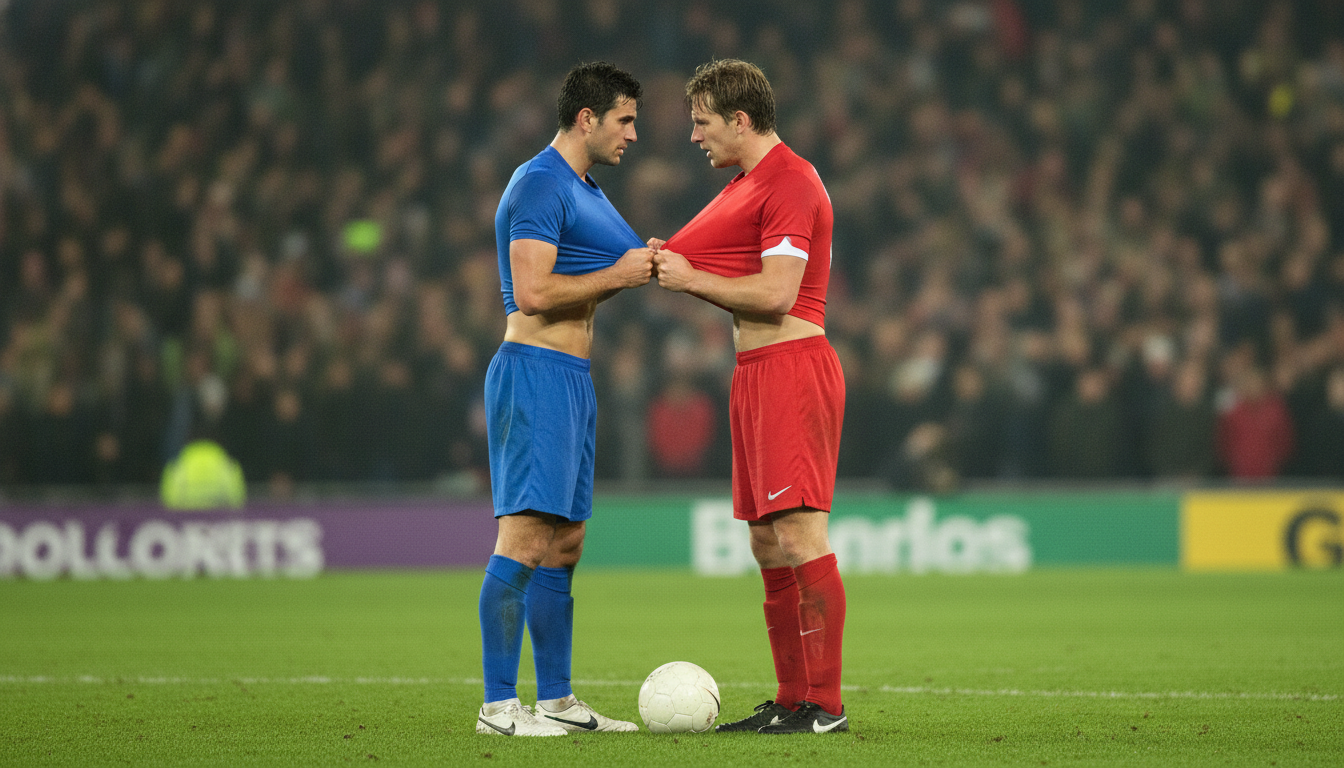
Why do footballers swap shirts after a match?
Why do footballers swap shirts after a match?
The final whistle goes, and within seconds two opponents who spent ninety minutes trying to beat each other are pulling their shirts over their heads and handing them across. Here is what is actually going on.

Two players meet near the centre circle or the tunnel entrance, shake hands, and one reaches for the hem of his shirt. The other does the same. They swap, sometimes with a brief embrace, and walk off holding a strip that still has the other man's number on the back.
This is a gesture of respect — nothing more complicated than that. One player wants a physical reminder of the opponent he just faced. The other is happy to give it.
The shirt is the most personal object a player carries onto the pitch. It has his name, his number, the badge of his country or club. Handing it over is a way of saying: I rate you, and I want something to remember this by. Receiving one from a famous or admired opponent carries the same weight as any other keepsake — it is proof the moment happened, something to keep rather than something to forget.
The tradition has been part of football for decades. It is not organised or prompted by anyone; players simply do it, and younger players grow up watching it and do it too. That is largely how it has survived — habit passed down through generations rather than anything written down or enforced.
The handshake or embrace that usually goes with the swap matters as well. The two gestures together — physical contact and the exchange of something personal — make the whole thing feel like a proper acknowledgement rather than a quick transaction. After a hard match, that can mean something to both players.
Shirt swapping happens most often after international matches or high-profile club games. The bigger the occasion, the more likely players are to want a memento of it. A player who rarely faces a particular opponent — or who may never face them again — has more reason to ask for the shirt than someone who plays against the same clubs every season.
The one thing that changes the calculation is practicality. A player who has already given his shirt away has nothing dry to wear for post-match interviews or the walk back through the stadium. Some players swap shirts in the tunnel or the dressing room corridor rather than on the pitch for exactly this reason — same gesture, slightly warmer setting.
Who asks whom is usually down to whoever moves first. There is no fixed protocol. A younger player might approach a more experienced opponent; two players of similar standing might both reach for their hems at the same moment. Occasionally one player asks and the other declines, though this is rare enough that it tends to be noticed when it happens.
The day's football, in your inbox at 7 AM. Nothing else.
Pick of the night's matches, what the transfer window's doing, and the one column you should read today. No ads. No tips. No operators.
One-click unsubscribe. We do not share emails.
Comments
Loading comments…