


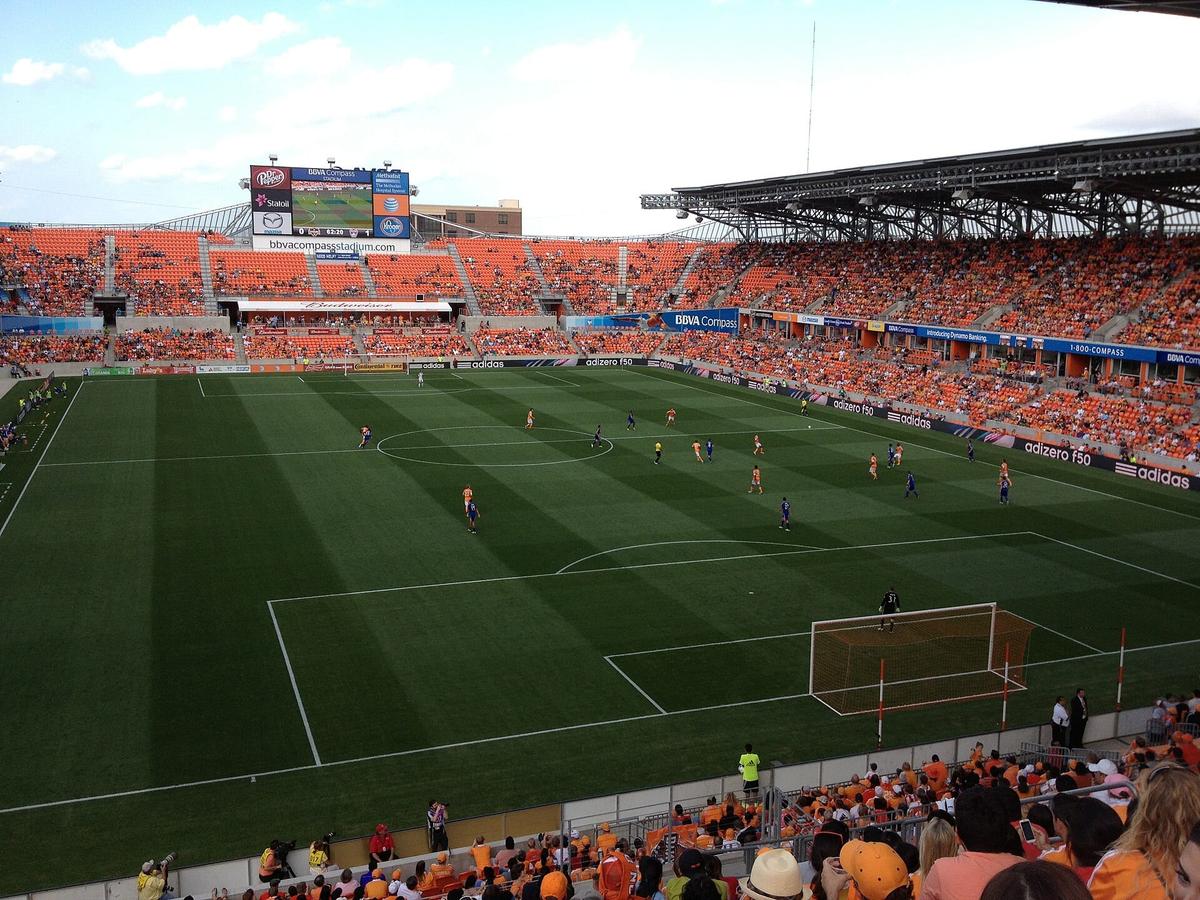
What happens if a football match ties?
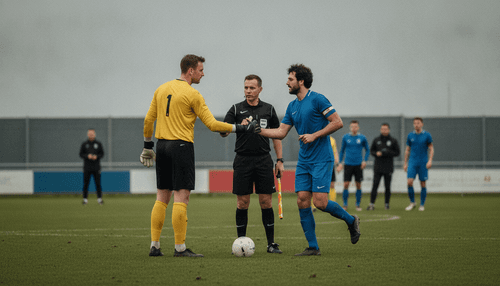
Photo: Victor Araiza from Houston, TX, United States of America / Wikimedia Commons (CC BY 2.0) · Source
The referee blows the final whistle and both sides have the same number of goals. Some players sink to the grass, others shake hands. In a cup tie nobody heads for the tunnel yet, because the night may not be over.
The short answer: a tied match is a draw, and in many games that is the end of it. Something else happens only when a competition needs a winner. Then the Laws list three procedures (away goals, extra time, penalties), and a competition may combine them.
The rule that settles this is Law 10 of the IFAB Laws of the Game, titled "Determining the Outcome of a Match". Its line on a tie: "If both teams score no goals or an equal number of goals, the match is drawn." A 0-0 is named in the rule as its own case. A draw is a full, finished result, not a match waiting for an ending.
When a winner is needed, Law 10 covers two situations: a single drawn match, and a home-and-away tie played over two legs that ends level. For both, it lists the procedures a competition may use. The first is away goals. The second is extra time, and the detail is tighter than most people expect. It must be two equal periods, and each can last no more than 15 minutes. "Equal" means you cannot play one period of 15 minutes and another of 10. "No more than" means 15 minutes is a ceiling, not a fixed length. The third procedure is penalties.
A competition does not have to pick just one. The Law says so in a single short sentence: "A combination of the above procedures may be used." That is how a tie can run into extra time and then, if the teams are still level, go on to penalties.
Why a shoot-out sits outside the match
Law 10 describes the shoot-out like this: "Penalties (penalty shoot-out) are taken after the match has ended and unless otherwise stated, the relevant Laws of the Game apply."
The shoot-out is taken after the match has ended. On the wording of the Law, the penalties are not part of the match itself. The match result is recorded as a draw, and the shoot-out decides who progresses. Individual competitions may present or record that outcome in their own way.
The second half of that sentence stops the shoot-out becoming a free-for-all. Unless something is stated otherwise, the normal Laws of the Game still apply during it. Where the shoot-out's own special rules say nothing, the ordinary Laws fill the gap.
Which method a competition uses
The Laws list what is allowed, but they never say which method a particular competition uses. One competition might go straight to penalties. Another might play extra time first. Another might use away goals in a two-legged tie. That choice sits in each competition's own rules, not in the Laws of the Game.
So if you want to know what happens when your team ties, the Laws give you the menu: away goals, up to two 15-minute periods of extra time, penalties, or a mix. The competition's own rules tell you which of those it has chosen.
Sources1 source
IFAB Laws of the Game — Law 10: Determining the Outcome of a Match, IFAB Laws of the Game — Law 10: Determining the Outcome of a Match, IFAB Laws of the Game — Law 10: Determining the Outcome of a Match
We name and link every outlet this article draws on, and rewrite their reporting in our own words rather than reprinting it.
More on Other football
See more

“Another angle on the same week.”
 MORE
Can a goalkeeper handle a back pass? Not if it was kicked to them
A defender rolls the ball back, a striker charges in, and the goalkeeper's first instinct is to grab it. The Laws of the Game say no, but only when the ball has reached them in a particular way.
Sign up for the Flagside newsletter.
We use your address only for the Flagside newsletter.
We do not share email addresses.
Comments
Loading comments…